Education Becomes Personal Again
AI is finally making learning personal again, giving every student a tireless tutor and every teacher the tools to reach each kid at their own level.

TL;DR: For 150 years, we've been running an education system designed for factories, not people. AI isn't replacing teachers or students. It's finally making learning personal again, giving every student a tireless tutor and every teacher the tools to reach the kids falling through the cracks. This is what happens when technology catches up to what great teaching has always been.
The System Was Never Built for You
Walk into any public school in America and you'll see the same architecture that's been there since the 1870s. Rows of desks. One teacher. Thirty students. A chalkboard (now a smartboard, but still).
The system was designed during the Industrial Revolution to create factory workers who could follow instructions, stay on schedule, and perform repetitive tasks. It worked brilliantly for that goal. For individuals? Not so much.
Think about your own education. How many times did you sit through explanations of concepts you already understood while the kid next to you was completely lost? How many times did you need help on something specific, but the class had already moved on? Trust me, we've all been there.
The reason is simple: one teacher managing thirty different learners at thirty different levels is an impossible job. We've known this for 150 years. We just didn't have an alternative.
Now we finally do. And I wish it existed when I was young.
The Calculator Panic of 1980
In 1980, teachers were terrified that calculators would destroy students' ability to do math. The fear was real, the headlines were dramatic, and school districts banned them from classrooms.
Today, we laugh at that panic. Calculators didn't make students worse at math. They freed students from tedious arithmetic so they could focus on understanding mathematical concepts, solving complex problems, and applying math to the real world. Besides, the calculator simply replaced the mechanical slide rule, itself a tool to help free our brain for more human things.
The fear wasn't about calculators. It was about change.
We're watching the exact same panic play out with AI in education right now. The headlines warn that AI agents will make students lazy, that they'll never learn to write, that teachers will become obsolete.
If a student is lazy, they still can be, but the tool didn't make them so. But if a new tool can ignite their imagination - or free the teacher to give them more attention - they might engage in ways never possible before.
What AI Actually Does in the Classroom
I spent years working on this problem. At Ellucian, I led the team building Competency Based Education tools we affectionately called "Brainstorm", using data and analytics to meet students where they actually were, not where a curriculum said they should be. At Apple, I rebuilt the Apple University Consortium under Steve Jobs, gathering feedback from CIOs to understand what students and teachers really needed which lead to the launch of the iMac.
The pattern was always the same. Students learned at different speeds. Teachers wanted to help every student but couldn't be in thirty places at once. The system forced both into a one-size-fits-all approach that served almost no one well.
AI doesn't replace the teacher. It multiplies the teacher.
Here's what that looks like in practice. A student is struggling with fractions. In the old model, they get one explanation during class, maybe some extra help if the teacher has time after school, and then the class moves on to decimals whether they're ready or not.
When I was in high school, I was excited about a calculus topic called "Solids of Revolution" where you take a two-dimensional equation and spin it around an axis creating a three-dimensional shape. On a whim, I spun the equation around a different axis, and the volume changed but I did not understand why. My hand shot up, but my teacher did not have time to help me figure out why. (it's simple to see why now) Even though I was clearly engaged in the subject, she had to move on. Later she signed my yearbook with "I hope you find a teacher at college who can answer your questions better than me." Secretly, so did I.
With AI, that same student has a tireless tutor available 24/7. The AI can explain fractions in five different ways, offer practice problems tailored to exactly where the student is stuck, provide instant feedback, and adapt the difficulty in real time. It never gets frustrated. It never runs out of patience. It meets the student exactly where they are.
Meanwhile, the teacher gets something even more valuable. Visibility.
The AI shows the teacher which students are excelling (and might be bored), which students are stuck (and on what specific concept), and which students need a different teaching approach entirely. The teacher stops being an information delivery system and becomes what they always wanted to be: a mentor, a guide, a coach who works with each student as an individual.
This is what personalized learning actually means. Not a buzzword. Not a marketing pitch. Real human attention at scale.
The Students Falling Through the Cracks
The students who benefit most aren't the top performers or the ones who were always going to succeed. It's the students falling through the cracks.
The kid who's brilliant at math but struggles with reading, so they fall behind in every subject that requires text comprehension. The student who missed two weeks of school due to illness and never quite caught up. The learner who needs concepts explained visually instead of verbally. The child in a rural district where the school can't afford advanced placement courses.
AI gives each of them a personalized learning companion. It adapts to their learning style, their pace, their strengths, their gaps. It doesn't judge them for being behind. It just meets them where they are and helps them move forward.
The Real Concerns (And Why They Matter)
Access and equity are real concerns. If AI tutors are only available to students whose parents can afford them, we've just made the education gap worse, not better.
That's why partnerships like Khan Academy's Khanmigo matter. Free AI tutoring for any student with internet access. Tools integrated directly into Google Classroom and Microsoft Teams that teachers already use. Large language models that can explain concepts in dozens of languages for students whose first language isn't English.
The technology exists. AI makes this possible with 30 students and a public school budget. The question is whether we deploy it equitably or let it become another advantage for those who already have advantages.
Teachers also need training. Not "here's another piece of software to figure out on your own" training, but real professional development that helps them understand what AI can and can't do, how to interpret the insights it provides, and how to use the time it frees up to do the deeply human work of teaching.
The goal isn't to remove teachers. The goal is to give them superpowers.
Apple at 50: Steve Jobs and Education
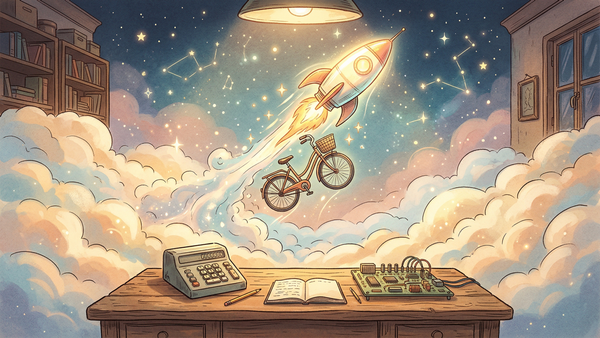
Steve Jobs used to call computers a "bicycle for the mind." He believed technology could amplify human cognitive abilities the same way a bicycle amplifies physical movement. Not replace the rider. Amplify them.
At Harvard Business School in the early 1990s, we standardized the entire institution on Mac and created 25 multimedia products specifically for their curriculum. We built the world's first multimedia CD-ROM with digital video to engage students intimately. This wasn't just about selling computers. It was about changing how students learned. Those students weren't your typical college students - they were senior executives in their 40s and 50s who learned to use computers for the first time as part of HBS's Program for Management Development, part of its ongoing Executive Education program.
In 1997, Jobs rehired me to help enhance Apple's Education efforts. We worked together to reconstitute the Apple University Consortium, partnering with CIOs from 28 leading universities. The goal was simple: get Macs into students' hands during their college years, and they'd become lifelong Apple evangelists. What wasn't revealed was those schools helped Apple make MacOS X possible by building some of the code deep inside the kernel. It worked.
Jobs loved the education market, but discovered something important along the way. Technology alone wasn't enough. You needed great content. You needed publishers. You needed educators who understood both the medium and the message. You needed human passion.
Fast forward to today, and AI is fulfilling that original vision in ways Jobs could only imagine. The "bicycle for the mind" is no longer just amplifying what you already know how to do. It's teaching you. It's adapting to your learning style. It's answering your 3 AM questions about organic chemistry or Renaissance history without judgment.
I've started calling AI a "rocketship for the mind." The bicycle got you moving faster. The rocketship takes you places you could never reach alone.
Jobs saw education as Apple's critical foothold because he understood something fundamental: if you change how someone learns, you change their life. As Apple celebrates its 50th birthday next month, AI is proving he was right all along.
The bicycle became a rocketship.
What This Looks Like Five Years From Now
Imagine a classroom in 2031. The teacher knows exactly where each student is, not because they spent all night grading, but because the AI provided a dashboard showing progress, struggles, and breakthroughs. Office hours aren't just for the students who already know how to advocate for themselves. They're for the quiet kid in the back who the AI flagged as stuck on a concept for three days straight.
The advanced students aren't bored. They're working on college-level material the school district could never afford to teach. The struggling students aren't falling further behind. They're catching up because they finally have the individualized attention they've always needed.
The teacher isn't exhausted from trying to be everywhere at once. They're energized because they're finally doing the work they went into teaching to do: connecting with students as individuals, sparking curiosity, building confidence, showing someone that they're capable of more than they believed.
That's not a fantasy. That's what happens when we stop designing education for factories and start designing it for people.
Education Becomes Personal Again
Before mass education, learning was personal. A tutor worked with a student. A mentor guided an apprentice. A teacher knew each pupil's strengths, weaknesses, and potential.
We gave that up for scale. We had to. There was no other way to educate millions of students.
AI gives us scale and personalization.
Every student can have a tutor. Every teacher can mentor instead of lecture. Education can optimize for the individual again, not the factory line.
The technology isn't the hard part. The hard part is choosing to use it in a way that empowers both students and teachers instead of replacing one or exploiting the other.
I'm optimistic about what happens next. Not because the technology is perfect (it's not), but because I've spent three decades watching educators try to do the impossible with the tools they had. Now they finally have tools that match their ambition.
The students who grow up with AI tutors won't remember a time when learning meant sitting through explanations that didn't fit how their brain works. They'll expect education to meet them where they are. They'll expect their potential to matter more than their zip code.
And the teachers who embrace this shift won't remember it as the thing that replaced them. They'll remember it as the thing that finally let them teach.
What's more human than teaching the next generation to improve the world?
Steve Chazin makes AI make sense. After three decades leading tech teams at companies like Apple and Salesforce, he's on a mission to show regular people how to use AI without fear or confusion. Welcome to the Digital RenAIssance. stevechazin.com