How AI Will Make You More Valuable at Work
The fear that AI will take your job is real and understandable. But the data tells a different story. Yes, AI is replacing entry-level textbook knowledge but amplifying the value of human experience, judgment, and the kind of wisdom you can't learn from a manual.

TL;DR: Do you see AI as a threat or the most powerful amplifier humans have ever built? The fear that AI will take your job so far hasn't proven true - at least not yet. What is true is AI is not coming for the parts that make you human. Your judgment. Your experience. Your capacity to care about outcomes, not just outputs. And if you play your cards right, AI can make you much more valuable to your employer.
The Question Everyone's Asking
After 30 years in technology, here's what I've learned about job anxiety. Every time a fantastic new tech arrives, we have the exact same conversation. "This time it's different. This time these new machines will replace us completely." Yet each time, humanity not only survives, but thrives.
At one point in the 20th century, more than half of all Bell Telephone employees were telephone operators, and nearly all of them women. 340,000 of them sat at massive switchboards with hundreds of patch cables, connecting calls by hand, memorizing area codes, navigating the complexities of long-distance routing. Their job was intricate. Skilled. Essential. Every business and every family in America, and soon the entire world, relied on these humans to connect every single telephone call. No one could imagine life without the "hello girls."
When automated switching arrived, their job transformed overnight.
"The humblest hello-girl along ten thousand miles of wire could teach gentleness, patience, modesty, manners, to the highest duchess in Arthur's land". - Mark Twain, A Connecticut Yankee in King Arthur's Court
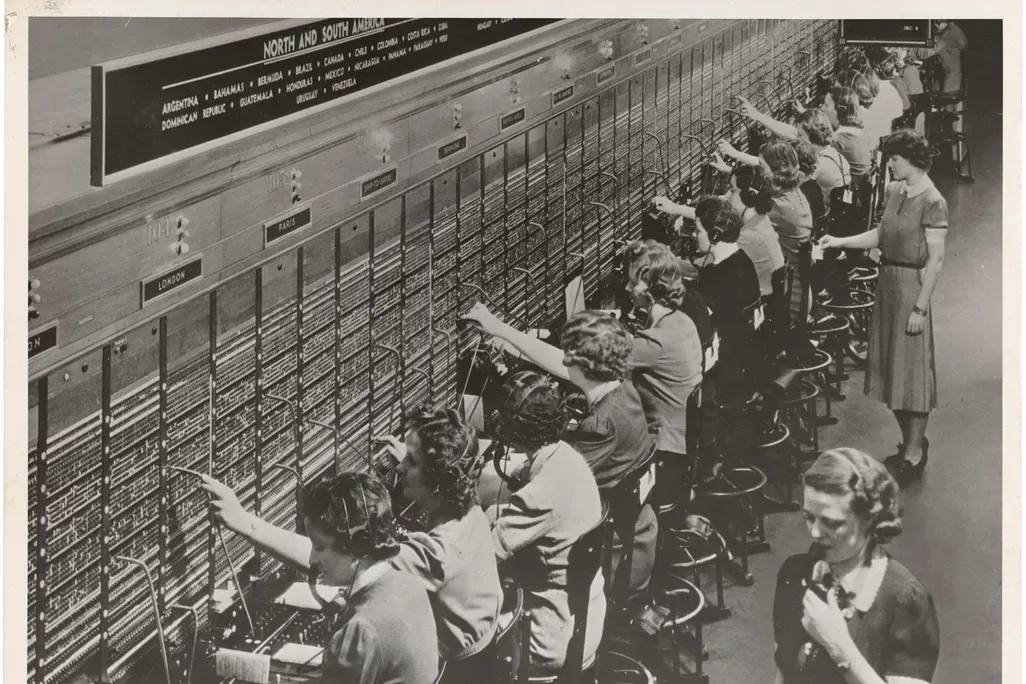
And here's what happened next. The telecommunications industry exploded. New jobs emerged that nobody could have imagined. Network engineers. Customer service specialists. Call center designers. Installation technicians. The machines took over the mechanical work. The humans moved up to work that required judgment, empathy, and creativity. Those women rose up the skill chain and landed jobs at answering services for doctors and businesses, while others work today in security monitoring centers and suicide hotlines helping humans in crisis.
That pattern has repeated itself through every technology shift I've witnessed. Calculators didn't kill math teachers. The internet didn't eliminate retail. ATMs didn't replace bank tellers. In fact, banks opened more branches after ATMs arrived because the cost per transaction dropped so dramatically that expansion became profitable.
The work transformed. It didn't vanish.
What the Data Actually Shows
Here's what's happening right now, not speculation but actual measured reality.
Total U.S. employment has increased 2.5% since ChatGPT launched in fall 2022. Not decreased. Increased.
But that headline number hides something important. The Federal Reserve Bank of Dallas published research that shows AI is doing something fascinating and specific. It's simultaneously replacing some workers and amplifying others.
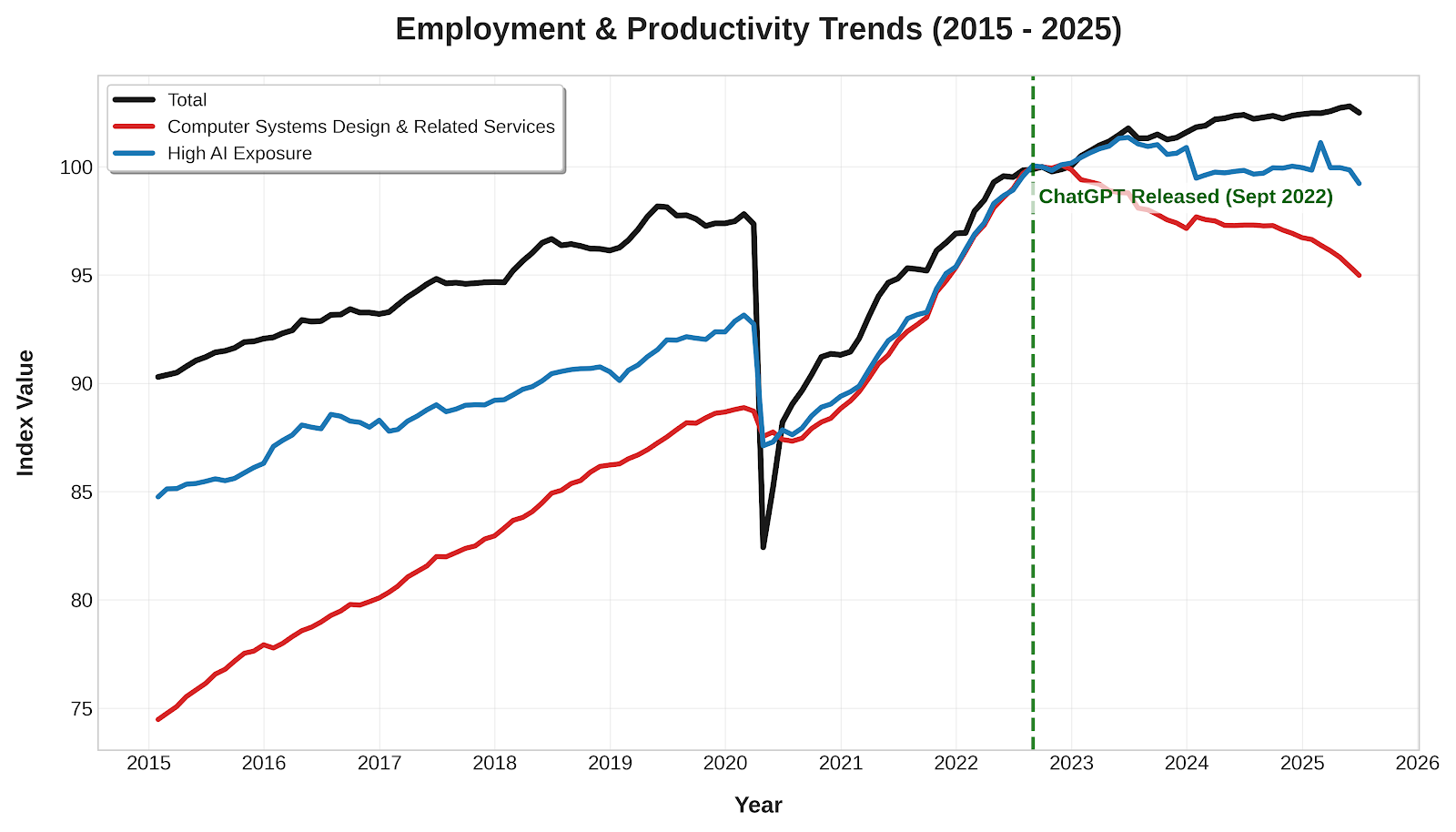
Young workers entering AI-exposed fields are facing tough job markets. Companies are eliminating some entry-level positions. That's the scary headline everyone focuses on.
But experienced workers in those same fields? Their wages are rising faster than national averages. In computer systems design, wages have grown 16.7% since ChatGPT launched, compared to 7.5% nationwide.
What's going on?
The Knowledge That Machines Can't Touch
AI is incredibly good at codified knowledge. The stuff you learn from textbooks. Established procedures. Documented processes. If you can look it up in a manual, AI can probably do it faster than you can.
But AI is terrible at tacit knowledge. The understanding you build from experience. The ability to read a room. The judgment to know when the rule book doesn't apply. The wisdom to see what a situation really means, not just what it says on the surface. The traits we laud in people like Steve Jobs or Martin Luther King, Jr.
Think about what that security monitoring operator does. Five years ago, they spent hours reviewing camera footage frame by frame, looking for anomalies, trying to catch the one meaningful event in thousands of routine ones. Mind-numbing work that burned people out.
At Alarm.com, where I led next-gen ambient sensing and AI solutions, I watched this transform in real time. AI agents now analyze data from networks of cameras and sensors, identifying potential threats with speed and accuracy no human could match. The AI becomes the tireless analyst, combing through vast amounts of data to surface patterns and feeds that information instantly to the people who make the real decisions.
The human operator. They're doing what humans do best. Applying critical thinking. Drawing on years of experience. Making judgment calls. Taking decisive action. The AI tells them where to look and what might be happening based on data the human doesn't have, yet the operator decides what it really means and what to do about it.
That's not replacement. That's acceleration.
And it's why the operators with the most experience, the ones with deep tacit knowledge, are seeing their value skyrocket while entry-level positions shrink.
The Entry-Level Challenge
I'm not going to pretend this shift doesn't create real problems.
If you're graduating with a degree in computer science or business analytics or financial services, the job market looks different than it did five years ago. Companies used to hire junior employees to do routine analysis, data entry, first-pass research. Those tasks built the foundation for learning tacit knowledge on the job.
Now AI can handle 80% of that work in 5% of the time.
The traditional ladder, where you start at the bottom doing textbook tasks while slowly learning the experiential wisdom to become valuable, is breaking. Firms are finding that model cost-ineffective in the short run. So if you're looking for a job, stop ignoring AI. Use it, then add that skill to your resume. If you already have a job, do the same thing.
Leaving new employees off the ladder isn't sustainable in the long run either. Every experienced worker started as a beginner. If companies stop developing talent, they strangle their own future. Not to mention, layoffs eventually harm every employer who needs customers that can afford their products.
What has to change isn't whether we need humans. It's how we build experience when the routine tasks disappear.
A new Gallup study (attached below) of Gen Z just came out, and the results are surprising to me: their usage has completely stalled since 2025.
Excitement is down. Hopefulness is down.
Almost all of them believe using AI tools will actually make it more difficult for them to learn in the future. Some see it as a shortcut that costs them their own development. Others find they are now tasked simply to correct AI-generated content that looks perfectly polished but requires hours of human correction to actually use, AKA "workslop."
The workplace is rapidly expanding AI access, but the youngest workers are pushing back. They do not trust the output, and some are worried about losing their critical thinking skills, while still others don't want to do much hard thinking at all.
Which tells you something important: the people most anxious about AI are the ones with the most to gain from it.
If you need help retraining yourself or your employees for AI, contact me.
Your Real Opportunity
For the past fifty years, truly harnessing computer technology required speaking the machine's language. You needed to learn code, understand databases, navigate complex interfaces designed by engineers for engineers.
That era is over.
AI finally learned to speak human. You can now describe what you want in plain English and watch it materialize. You can ask questions and get answers that actually make sense. You can imagine solutions and guide the AI to build them, without needing a computer science degree.
Think about what that means. The gap between imagining something and building something is disappearing. Imagine what you can now do in your job with these tools. Never before have you been able to achieve so much without mastering the tools older employees had to learn simply to realize those thoughts.
We're entering what I call the Digital RenAIssance. Not because AI replaces human creativity. Because it unlocks it. Because for the first time in history, you don't need to become a technical expert to leverage the most powerful tools ever created.
The question isn't whether AI will eliminate jobs. The question is whether you'll learn to work with it as a partner.
What AI Still Can't Do
AI can write a beautiful essay about heartbreak without ever feeling sad. It can explain quantum physics without understanding a single equation. It's matching patterns from millions of examples, not comprehending meaning the way you and I do.
And that limitation is everything.
AI cannot comfort a frightened homeowner during a break-in. It cannot read body language in a tense client meeting. It cannot mentor a junior employee through their first major presentation. It cannot adapt strategy on the fly when a project goes sideways because someone's personal situation changed.
Those skills? Irreplaceable.
When I built Dream Weaver, my AI-powered bedtime story app, the technology generates personalized stories in seconds based on what kids love. But the magic isn't in the AI. The magic is in the parent sitting next to their child, adapting the story in real time, adding the details that matter, creating the connection that machines never can.
The AI scaffolds the structure. The human brings the soul.
Terrifying if You're Coasting. Liberating if You Love the Craft.
I've watched this movie before. At Cisco. At Salesforce. At Apple when Steve Jobs returned and we had to save the company. The professionals who thrived weren't the ones with the most technical expertise. They were the ones who embraced change fastest and learned to leverage new tools as force multipliers.
AI is coming for the boring parts of your job. The repetitive analysis. The data entry. The endless monitoring of systems that rarely change.
It's not coming for the parts that make you human. Your judgment. Your experience. Your ability to read a situation and know what it really means. Your capacity to care about outcomes, not just outputs. If anything, AI just made you more valuable.
The era ahead belongs to people who master the partnership. Who see AI as a tireless analyst that surfaces insights so you can focus on what those insights mean. Who treat it like the assistant who never sleeps, never complains, and gets faster every week.
That's not a threat. That's liberation.
What This Means for You Right Now
If you're early in your career, the playbook changed. You need to build tacit knowledge faster because the routine tasks that used to teach it are vanishing. Seek mentorship. Find roles where you're solving problems that don't have clear answers. Get experience making judgment calls, not just following procedures.
If you're mid-career with experience, you're entering the most valuable phase of your professional life. The knowledge in your head, the pattern recognition you've built from years of practice, the wisdom to know when the rule book doesn't apply? AI makes that more valuable, not less. Because now you can amplify your judgment across 100x more work than you could handle alone.
If you're worried AI will eliminate your role entirely, ask yourself honestly: what percentage of your job is pure pattern matching from codified knowledge, and what percentage requires human judgment, empathy, and context? If it's mostly the former, you're right to be concerned. Learn the latter. Fast.
Your opportunity is simple. Every employer is desperately looking for creative human brains to wield these tools to accelerate the growth of their businesses.
AI will likely do for our minds what gears and machines did for our muscles. Not replace them. Amplify them.
How will you use this amplification in your work this week?
Steve Chazin makes AI make sense. After three decades leading tech teams at companies like Apple and Salesforce, he's on a mission to show regular people how to use AI without fear or confusion. Welcome to the Digital RenAIssance. stevechazin.com