
The Company That Builds Tomorrow: Inside Nvidia's Trillion-Dollar AI Roadmap
Nvidia's CEO just stood on stage for three hours and revealed over $1 trillion in AI revenue visibility through 2027. Read the full story.

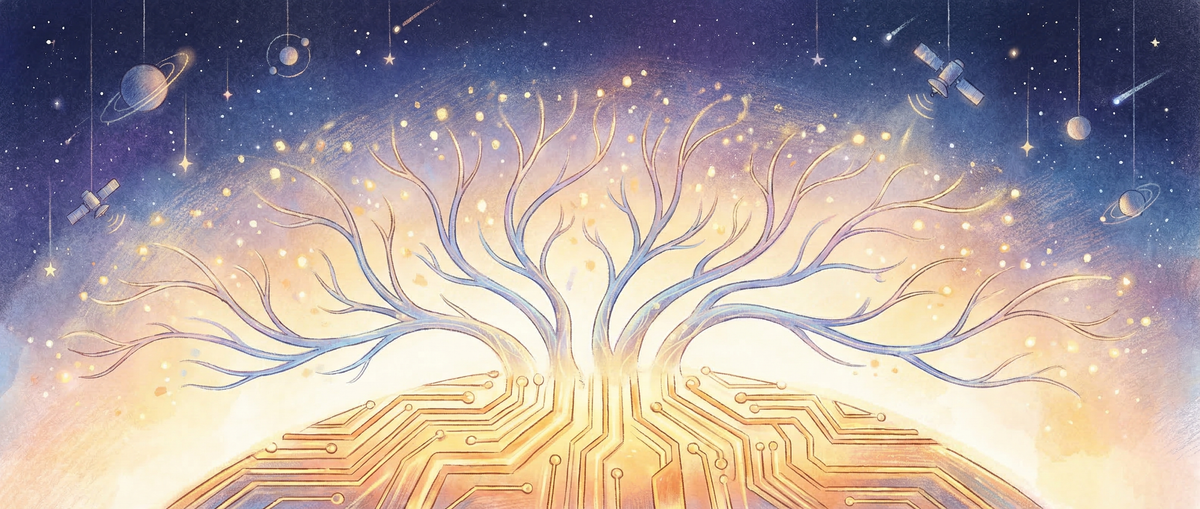
TL;DR: Nvidia's CEO just stood on stage for three hours and revealed over $1 trillion in AI revenue visibility through 2027. The company that makes the chips powering every major AI breakthrough also announced it's building data centers in space and partnering with Disney to create AI-powered robots. This isn't just Nvidia's roadmap. This is the blueprint for what AI becomes next.
The Company That Builds Tomorrow
For the past fifty years, predicting the future of computing meant watching Microsoft. If you wanted to know where software was headed, you watched Bill Gates.
That era is over.
If you want to understand where AI is going, you watch Jensen Huang. And last week at GTC 2026 in San Jose, he gave us a three-hour master class on exactly that.
Nvidia's market cap just hit $5 trillion. That's not a typo. Five trillion dollars. They're not just the biggest company by valuation. They're the engine driving the entire AI industry. OpenAI, Google, Anthropic, every company building AI agents and large language models relies on Nvidia chips to make it work. When Nvidia moves, the whole ecosystem follows.
So when Jensen Huang reveals over $1 trillion in revenue visibility through 2027, that's not a forecast. That's a glimpse at what's already in motion.
What Actually Happened on That Stage
The announcements came fast. Disney partnership to build AI-powered robotics. A surprise appearance by Olaf, the snowman from Frozen, now an autonomous droid combining Disney's character IP with Nvidia's machine learning platform. A new developer framework called NemoClaw, inspired by the viral OpenClaw phenomenon that's swept through the tech world in recent months.
And then the kicker: Nvidia is exploring data centers in outer space.
Let that sink in for a second. Space. Data centers. In orbit.
Why? Because the computing demands for AI aren't slowing down. They're accelerating beyond what Earth-based infrastructure can handle efficiently. Nvidia isn't just responding to today's AI needs. They're building for the AI we'll need in 2030, 2035, and beyond.
The Inflection Point Nobody's Talking About
Here's the part that matters most, and it's technical but I promise it's worth understanding.
For the past few years, AI companies spent billions building models. Training GPT-4. Training Claude. Training Gemini. Huge upfront costs, but once the model was trained, it was done.
That's changing.
What's exploding now is the actual running of those models. Every question you ask ChatGPT. Every email an AI agent drafts. Every photo your phone recognizes. That's the AI doing work, and it requires massive computing power every single time.
Jensen Huang put it plainly: "AI is finally able to do productive work. The inflection point of inference has arrived. AI has to think - that requires inference. AI has to do work - that requires inference."
What the heck is inference? Think of it like the difference between building a car factory and running that factory. Building it is expensive, but you do it once. Running it: electricity, workers, materials, maintenance - that's the cost that never stops as long as you keep making cars.
AI just hit that shift. The models are built. Now they're running 24/7, processing billions of requests. And unlike a factory that closes at night, AI never sleeps.
Training happens once. Running the AI happens billions of times per day, forever.
Translation: The era of building AI is over. The era of doing actual work with AI has begun.
Why This Matters to You
I know what you're thinking. "Steve, I don't build AI models. I don't run data centers. Why should I care about Nvidia's roadmap?"
Because Nvidia's roadmap isn't about chips. It's because inference never stops. Every AI agent running on OpenClaw right now is processing requests constantly. Multiply that by millions of users, billions of tasks per day, and you start to understand why Nvidia is talking about space-based data centers.
When Nvidia partners with Disney to build AI-powered droids, that's not a tech demo. That's a signal. Character-based AI companions are coming. Robots that can interact naturally, learn preferences, adapt to your home or business.
These computing demands aren't a one-time spike. They're permanent, growing, and everywhere. Embedded in the fabric of everything we'll do.
When they announce NemoClaw, a development platform inspired by OpenClaw, that's validation. Agentic AI isn't a niche experiment anymore. It's the next platform shift, and Nvidia is building the infrastructure to make it ubiquitous.
When Jensen talks about the "inflection point of inference," he's telling you that AI is done being a novelty. It's becoming infrastructure. Like electricity. Like the internet. You won't "use AI." You'll just... live in a world where AI is embedded in everything you touch.
It's like electricity, but for on-demand brainpower.
The Trillion-Dollar Question
Over $1 trillion in revenue visibility. That's not speculation. That's contracts, partnerships, and commitments already in place. Nvidia knows exactly who's buying their chips, how many they need, and what they're building with them through 2027.
So here's the question nobody's asking: What are those companies building?
We know some of it. OpenAI's next models. Google's Gemini evolution. Anthropic's Claude improvements. But $1 trillion worth? That's not just chatbots getting slightly better. That's autonomous vehicles, personalized medicine, AI-native operating systems, smart cities, ambient computing at planetary scale.
Nvidia doesn't sell chips to companies with small ideas.
What Happens Next
The AI bubble debate will continue. People will argue whether $5 trillion is justified, whether the hype matches reality, whether we're overbuilding infrastructure we don't need yet.
I think they're asking the wrong question.
The right question is: What world are we building?
Because Nvidia isn't guessing. They're laying the foundation for an AI-native civilization. One where computing happens everywhere, intelligence is ambient, and the barriers between what you imagine and what you can create collapse entirely.
That's the Digital RenAIssance in action. Not in theory. In trillion-dollar commitments and three-hour keynotes that show you exactly what's coming.
How do you think AI will change your work or daily life in the next two years? What excites you? What worries you?
Steve Chazin makes AI make sense. After three decades leading tech teams at companies like Apple and Salesforce, he's on a mission to show regular people how to use AI without fear or confusion. Welcome to the Digital RenAIssance. stevechazin.com