The moment I realized wires could think
AI feels magical today the same way that first scientific calculator felt in the 1970s: something that only humans could do, suddenly happening inside a device you could hold in your hand. Technology has always amplified what we can do. AI is just the next bicycle for the mind.

I want to tell you about the moment everything changed for me.
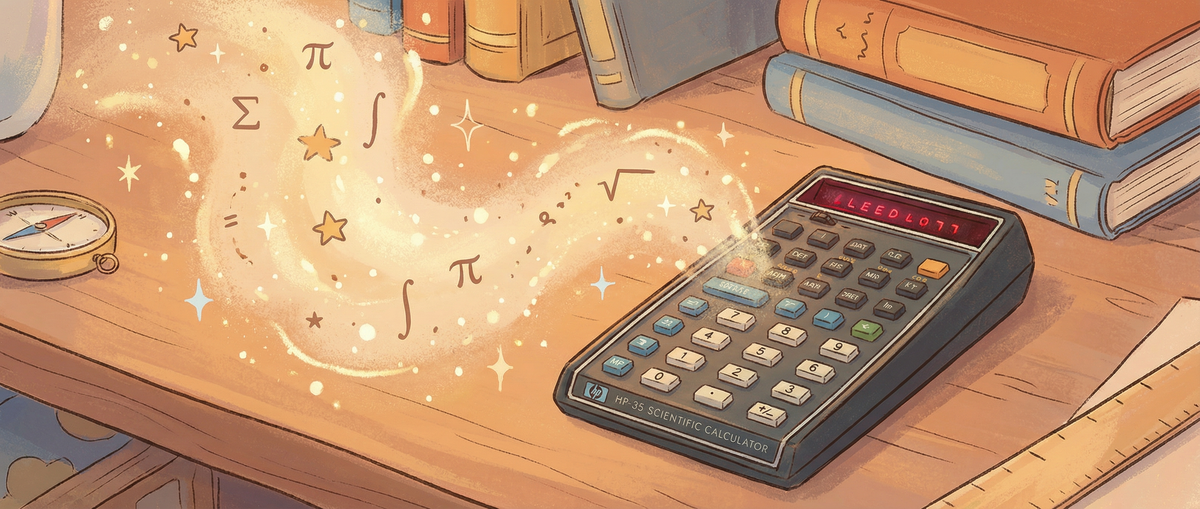
I was a kid watching astronauts walk on the moon, dreaming of doing the same thing when I grew up. Then my dad came home from his lab at RCA with a device that cost $395 (about $2,800 today). The HP-35 scientific calculator. He was so protective of it that he made us use it with one hand behind our back, pressing the buttons with only one finger.
I typed in 7 x 7 and watched 49 appear on the screen.
That moment stopped me cold. How could wires do what only humans could do? My dad said these were tiny circuits that could process math, but even he didn't fully understand how. "Wires that think," I called them. That mystery hooked me for life.
For the past fifty years, actually using computer technology required speaking the machine's language. I learned to arrange ones and zeros in just the right order to make computers understand what I wanted them to do. It was tedious, slow, and kept computing power in the hands of the few who could master it. That era is over.
Today, AI is doing something remarkable. It's taking what once required a computer science degree and making it as simple as asking a question. Want to build a game? Just ask. Need complex code written? Describe what you want in plain English. The same wonder I felt watching that calculator solve 7 x 7 is what people feel now when ChatGPT writes their first program or creates art from a simple prompt.
Steve Jobs called the personal computer a "bicycle for the mind." It amplified our abilities the way a bicycle amplifies our legs, moving computing out of guarded labs and into everyone's hands.
I think AI is taking that vision even further. It's a rocketship for the mind. It's not replacing what makes us human. It's amplifying it. Taking us places we could never reach alone.
I know the fear is real. Will AI take my job? Will machines replace human creativity? I hear these questions constantly, and they deserve honest answers. Yes, AI will change how we work. But so did calculators, personal computers, and the internet. Each time, we worried about what we'd lose. Each time, we discovered new possibilities we couldn't have imagined.
The calculator didn't make mathematicians obsolete. It freed them to tackle bigger problems. The computer didn't eliminate writers. It gave them tools to reach millions. AI won't erase human creativity and connection. It will amplify the people who embrace it and learn to work alongside it.
That kid pressing calculator buttons with one hand behind his back never walked on the moon. But he got to spend a career making technology more human, working for Steve Jobs to democratize computing, and now helping everyday people understand that AI isn't something to fear. It's something to explore.
How will you use AI in your life this week?
Steve