The Teleprompter For Everything
Here's how a nervous Broadway actor accidentally solved a problem nobody knew we had and how we're repeating history with AI.


TL;DR: For decades, we mocked politicians for reading off glass teleprompters because we thought it made them less authentic. We had the whole thing wrong: teleprompters free people to focus on genuine human connection. The exact same shift is happening right now with artificial intelligence, which is doing for human cognition what glass did for political speeches.
WebEx Saw this Coming
At Cisco, I helped WebEx become a verb right about the same time that the world realized the future of work would happen on video. After spending countless hours watching how people communicated through a webcam, I noticed a fascinating pattern. The smartest people often gave the worst presentations.
Every time you stand in front of people and try to speak without notes, your brain splits into two streams. One stream is trying to deliver the current thought with conviction. The other stream is trying to remember the next point to make. That's not a flaw, that's just how our brains work. And smart brains work extra hard to keep both streams flowing.
The answer? Read from your notes. But that's bad, especially on camera, because you have to break eye contact to glance at your lines. Worse yet, now you are reading instead of thinking. So you have a choice: either read from your notes and sound disinterested and robotic, or memorize your entire speech and try to deliver each point by heart. Both approaches take you away from reading the room and connecting with your audience.
We solved this problem for television a long time ago, but we spent the next seventy-five years misunderstanding the solution.
A Nervous Actor and Half a Suitcase
The teleprompter was invented in 1948 by a guy who was genuinely stressed out.
Fred Barton Jr. was a Broadway veteran making the jump to television, and he was struggling. In theater, you memorized one show and performed it hundreds of times. Same lines, night after night, until they were burned into your brain. Television was different. Live television meant new scripts constantly. New lines to memorize daily, sometimes multiple times a day. Cue cards helped, but they were a disaster waiting to happen. One nervous stagehand fumbling the flip between cards and you're on live TV with dead air.
Barton went to Irving Kahn at 20th Century Fox with an idea: what if we could connect those cue cards into a continuous scroll that moved at a steady pace? Kahn brought in Hubert Schlafly, an electrical engineer, who built the first teleprompter using half of a suitcase as the outer shell, rigging up belts, pulleys, and a motor to turn a scroll of butcher paper. The script was typed out in half-inch letters. A stagehand controlled the speed. The performer read while looking mostly straight ahead instead of down at scattered pages.
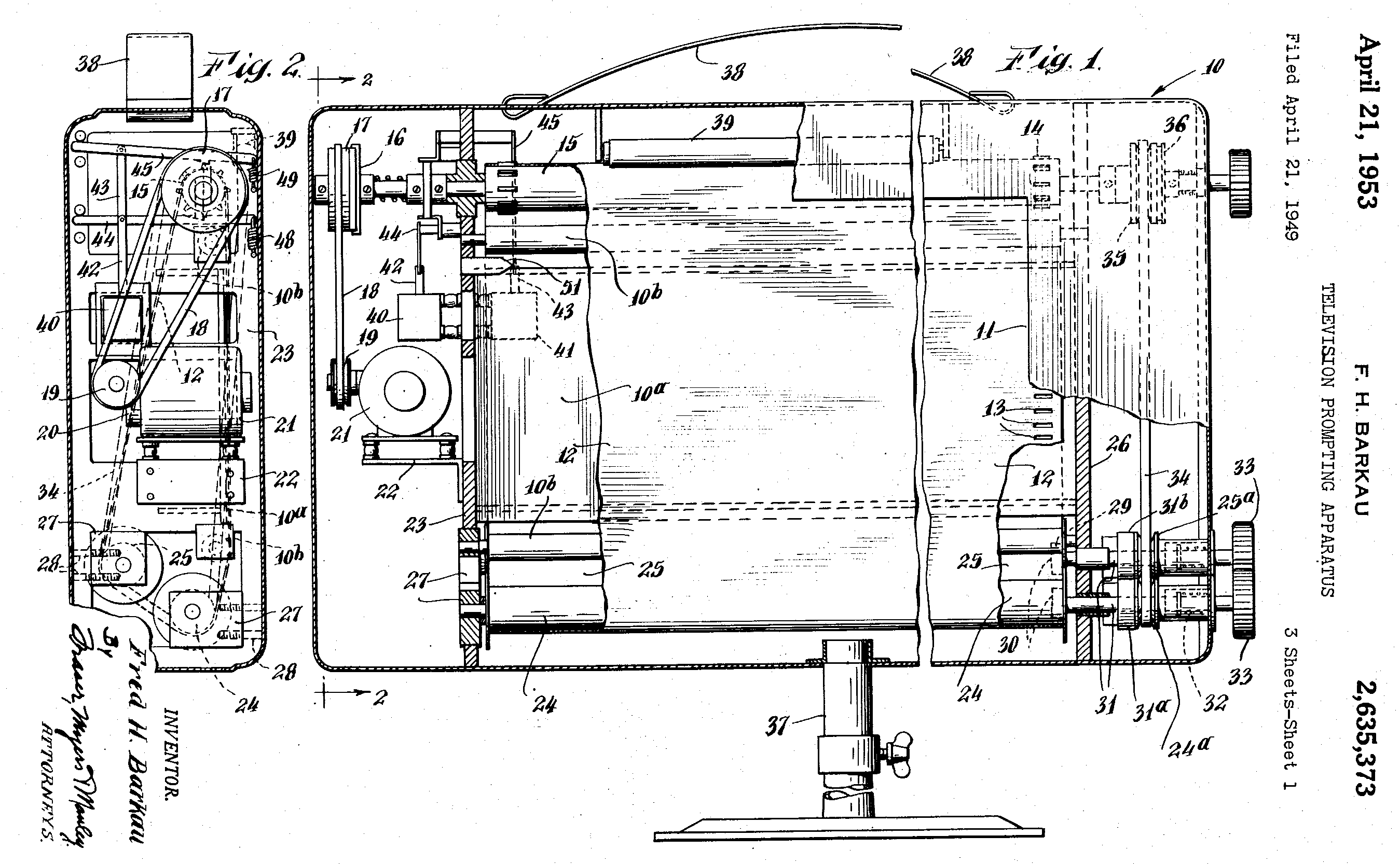
The insight here was never about helping actors cheat. It was about removing a cognitive burden that had nothing to do with the actual performance. Barton did not need help being a good actor. He needed his brain freed up from the panic of remembering his next line so he could focus on actually acting. The teleprompter did not make him less present. It made him more present.
That distinction matters, because we've spent the last 75 years pretending it doesn't.
The Myth of the Authentic Stumble
Politicians started using teleprompters, and immediately people decided this was evidence of something sinister. The criticism goes like this: if you need a machine to tell you what to say, you don't really believe it. Real passion is spontaneous and conviction comes from the gut, not from a script.
Kathleen Hall Jamieson, who studies political communication at the University of Pennsylvania, has spent years pointing out that this is nonsense.
"What the teleprompter did was increase the ability of the speaker to relate to the audience. There is a sense in which the speaker is communicating directly with you, when talking to the camera."
We want leaders to deliver complex arguments with perfect accuracy, be emotionally present, make eye contact, and never look down at their notes. You cannot hold all those things in your head at once and perform them flawlessly. The teleprompter solved a problem we created by expecting superhuman multitasking. It lets the speaker focus on delivery, tone, and connection instead of burning mental energy trying to remember statistics.
The teleprompter became a symbol of inauthenticity precisely because it worked so well at enabling actual connection.
AI is Today's "Teleprompter for Everything"
For decades, teleprompters remained expensive, bulky, and required a whole technical infrastructure that only made sense if you had a production budget. If you were a teacher recording a lesson or a small business owner pitching investors, you were stuck glancing at scattered notes. The tool itself became a marker of who got to communicate like a professional and who did not.
We now have a tool that does for all of human cognition what glass did for political speeches. Artificial intelligence is the teleprompter for everything. It removes the cognitive load of remembering, structuring, and delivering so your brain can focus on thinking.
And we are doing the exact same thing we did to those first teleprompter users. We are mocking it as fake.
When someone asks an AI to write an email, the complaint is that they did not write it themselves. When someone uses AI to brainstorm ideas, people say that is not their real thinking. But thinking has always been a collaboration between working memory and external tools. Before paper, thinking happened inside your head and vanished. Before adding machines and spreadsheets, accountants spent most of their cognitive load on arithmetic instead of what the numbers were telling them.
Consider what humans do when we communicate. We gather information from memory, structure it into a coherent narrative, express it in language others can understand, and adjust based on how the audience receives it. Each of these steps costs cognitive energy. Each one can now be augmented by AI. Not replaced, but augmented. The tool just removes the friction between your idea and its expression.
The Real Unfair Advantage
The teleprompter was never about faking anything.
It was about freeing your brain to focus on the part that actually matters: connecting with the person on the other side of the camera. When you're not scrambling to remember your next sentence, you can focus on how you're saying it. You can modulate your tone. You can pause for emphasis. You can make eye contact. You can be present.
That's what Barton needed in 1948. That's what Obama needed on the campaign trail. That's what you need when you're recording a pitch, teaching a class, or explaining an idea. It's the reason I created Tellie, a teleprompter app that listens and follows your voice to automatically scroll your script and help you say what you came to say.
The meta-twist here is that Tellie was built using AI to write code I don't know how to write. The tool that enables individual capability was created using tools that enable individual capability. It's turtles all the way down, except every turtle is a person who used to need a team and now doesn't.
A teacher can now record a lesson with the same polish as a educational YouTuber with a production team. A startup founder can pitch investors with the same confidence as a Fortune 500 CEO with a speechwriter. A creator can record a video essay without the constant mental load of "wait, what was I going to say next?"
The playing field doesn't just level. It inverts.
The teleprompter proved that anyone can speak clearly if you remove the memory burden. AI proves that anyone can think clearly if you remove the cognitive friction. Authenticity means your idea reaches the audience without distortion from cognitive overload. Speaking of authenticity, I know the word "listens" make some people nervous in 2026, so I made sure that Tellie keeps everything private to your Mac. It's also why I created this promise to my users.
That original teleprompter was never about hiding something. It and its descendants like Tellie are about revealing what you actually want to say. In the past, that clarity belonged to politicians and anyone with a production budget.
Now it belongs to everyone. Free.
P.S. While AI and I built a simple teleprompter back in May, Tellie has steadily evolved into a silent co-pilot built that solved the real reason teleprompters were invented: ensure you say everything you came to say. Tellie is now not just a teleprompter. I call it world's first voice-aware “Unprompter.” Please try Tellie and let me know how I can make it even better.
