Your Rocketship is Ready
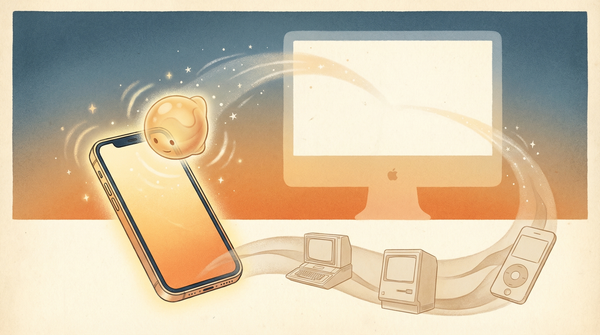
For fifty years, computers were bicycles for the mind, amplifying what we could do. AI is different. It's taking us to places we could never reach alone. As NASA sends humans back to the moon and Apple marks 50 years of making technology human, the real transformation isn't in machines. It's in us.

I vividly remember tugging at my dad's pant leg, looking up at him while we watched grainy black-and-white footage of astronauts walking on the moon, and telling him that when I grew to be his age, I'd be doing the same thing. Walking on the moon seemed like the most incredible thing humans could ever do.
The Epiphany of a Seven Year Old
Four years later, and my dad brought home the first scientific calculator normal humans could buy: the HP-35, named for the 35 buttons on its face. It cost about $395 then, which is roughly $2,800 in today's money. My dad didn't want to get in trouble for breaking it, so he made us come in one at a time, one hand behind our back, and use only one finger to press the buttons.
I was seven. I entered 7 × 7, hit enter, and it thought about it for a moment. 49.
I was stunned. How?
Then I entered the largest equation my little seven-year-old mind knew: 12 × 12.
It took a bit longer this time. 144.
How can it do this?
Then I had what I can only describe as a seven-year-old's epiphany. I decided to try an equation I didn't know the answer to: 123 × 123. This time it definitely took longer. 15,129.Then I decided to try an equation I didn't know the answer to: 123 × 123. This time it definitely took longer. 15,129.
I looked up at my dad, totally bewildered. I thought the calculator was doing what I'd been taught to do, which was essentially memorize numbers in a times table. But it couldn't have memorized that equation. So how did it know?
My dad looked down at me, and I could see he knew he had me. He said, "Well, son, these are called integrated circuits." He explained they were tiny wires, shrunk down and put on a chip inside the calculator, and that chip did the math.
I thought about it for a second. "Dad, so it's little wires?"
"Yeah."
"Dad… how can wires think?"
My dad didn't have an answer to that equation.
That question changed my life. I realized right then that being an astronaut couldn't come fast enough, because my dad told me it was computers like that calculator that made it possible for us to go to the moon in the first place. We couldn't have done it without them.
The Bicycle Era Is Over
A few years later, I got glasses. Someone told me I couldn't be an astronaut anymore because to be an astronaut you first had to be a pilot, and to be a pilot you needed perfect vision. My dreams of going to the moon died that day.
But my fascination with computers didn't.
Eventually, I got to work for one of my heroes: Steve Jobs. I asked him once why he started a computer company and he told that he was frustrated that all this new technology was locked away in air-conditioned rooms, guarded by what he called "the white-coated priests of the computer room." He was afraid this technology, like others before it, would only be for a few people. He wanted to unlock it and give that power to everyone.
The second thing I learned was an article he'd read in the early 1970s. Scientific American did the math on how much energy it takes to move an object from point A to point B based on its weight. Humans showed up somewhere in the middle, not much more efficient than a sheep or a cow. But somebody measured a human on a bicycle, and it turned out we were way more efficient than anything else on earth.
Steve thought this was a great metaphor for early computers. He came up with this idea of the computer as a "bicycle for the mind." Just like gears and machines amplified human muscles, computers would amplify human minds.
And it worked. Computers changed our lives.
The Rocketship Difference
Last year, I had an idea for an app that texts custom stories to busy parents at bedtime. Something to help parents connect with their kids through stories tailored to what each child loves. Dinosaurs. Space. Magic.
I wrote one paragraph describing what I wanted.
Three weeks later, using Google Firebase Studio, I had a working app. Dream Weaver. Real users. Real bedtime stories.
Here's the thing: I couldn't have built that in 1990. I couldn't have built it in 2010. I couldn't have built it in 2020. Not because the tools got faster. Because the gap between "I wish this existed" and "I made it" collapsed entirely.
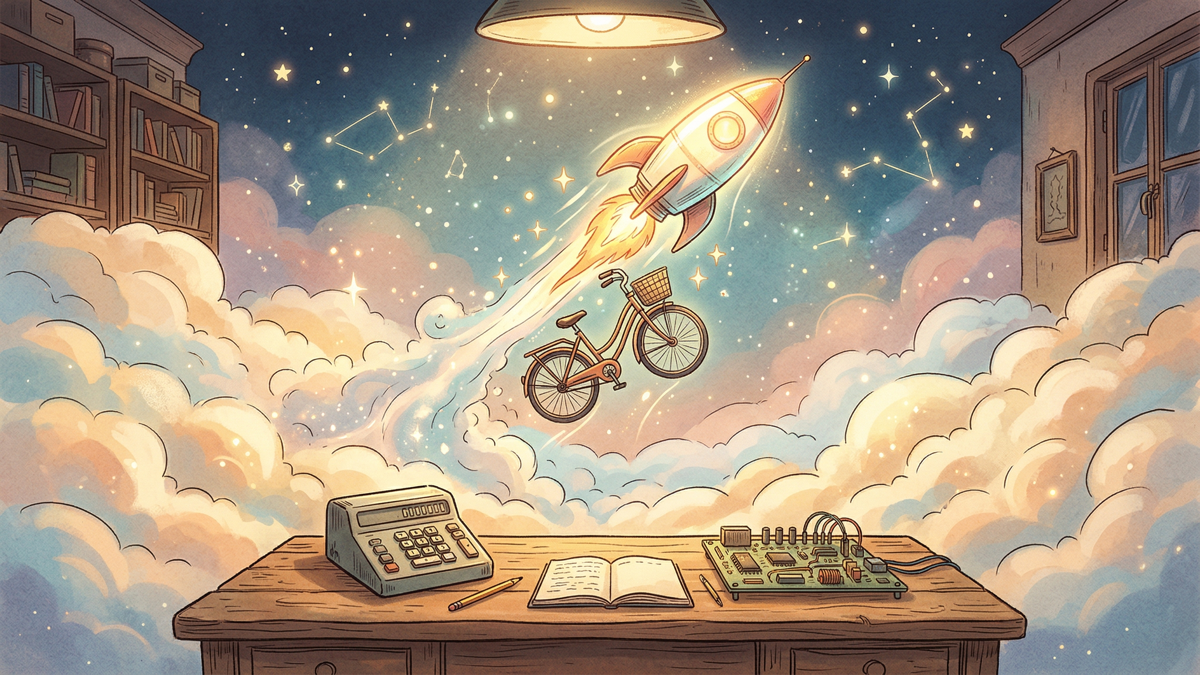
That's not a bicycle. That's a rocketship.
A teacher in Ohio is building custom tutoring software for her classroom. A journalist in Brooklyn created a research tool that scans fifty years of local archives in seconds. A teenager in Mumbai launched an app that translates legal documents into plain language for her community.
None of them are coders. None of them could have done this five years ago. They're not pedaling faster. They're going somewhere they couldn't reach before. They are the first citizens of this Digital RenAIssance - the unlocking of human potential now that any idea can be realized with the help of AI.
Our New Human Condition
We are standing at the threshold of the greatest expansion of human creativity in history, the Digital RenAIssance. Because of AI, we each have a personal rocketship that changes everything:
You do not need to be a trained illustrator to produce art.
You do not need to be a trained filmmaker to make movies.
You do not need to be a trained musician to make music.
You do not need to be a trained programmer to change the world.
The barrier to entry has collapsed. The "how" has been solved.
The only question now is "what do you want to create?"
The Real Moon Shot
NASA's Artemis II is the first crewed lunar mission since 1972, the same year my dad brought home that calculator. Apple just celebrated its 50th anniversary, marking half a century of making technology feel more human.
These milestones matter, but not for the reasons you might think.
The moon landing wasn't just about walking on another celestial body. It was about showing humanity what we could achieve when we stopped thinking small. Apple's legacy wasn't just about building beautiful computers. It was about proving that technology could belong to everyone, not just the priests in the air-conditioned rooms.
AI is doing the same thing right now, but bigger.
Steve Jobs called the computer a bicycle for the mind because it amplified what we could already do. It made us faster, more efficient. But AI isn't just making us faster. It's taking us to places we could never go alone.
That's not amplification. That's transformation.
The Rocketship is You.
Here's the thing people miss when they worry about AI taking their jobs or making humans obsolete.
AI isn't the rocketship. You are.
AI is the fuel. The guidance system. The propulsion. But without you - your curiosity, your creativity, your humanity - it's just an empty machine sitting on a launch pad going nowhere.
When I was seven, I asked my dad how wires could think. The truth is, they can't. Not really. What they can do is take your thoughts, your questions, your ideas, and launch them into orbit. They can take you to places you didn't even know existed.
I never walked on the moon. But that kid pressing calculator buttons with one hand behind his back got to spend a career making technology more human. I got to work for Steve Jobs. I got to build systems that keep families safe. I got to watch AI help save my father when he fell alone in his home in Florida, because the technology I helped build tapped me on the shoulder and said, "Something doesn't look right with your dad."
That's what AI does. It doesn't replace you. It doesn't make you obsolete.
It takes you faster and farther than you ever imagined possible.
The Question
So here's my question for you: Where do you want your rocketship to take you?
Not where AI is going. Not where technology is headed. Where do you want to go that feels just out of reach right now? What problem do you want to solve? What idea do you want to explore? What piece of your life feels like it's stuck on a bicycle when it could be launching into orbit?
Because the technology is here. The fuel is ready. The launch pad is built.
All that's missing is you deciding to get on board.
The only limit left is imagination.
For fifty years, we asked: How do I use this? Now the only question is:
Where is your rocketship taking you?
Steve Chazin makes AI make sense. After three decades leading tech teams at companies like Apple and Salesforce, he's on a mission to show regular people how to use AI without fear or confusion. Welcome to the Digital RenAIssance.
If this helped, subscribe at stevechazin.com for weekly updates. And if you know someone who's trying to make sense of AI, forward this to them. We're all learning this together.