A Reason to Look Up
Forty people in a bar on a Friday night, and every single one of them is staring at their phone. I spent 20 years imagining a tool that would give them a reason to look up. Last week, AI finally let me build it.

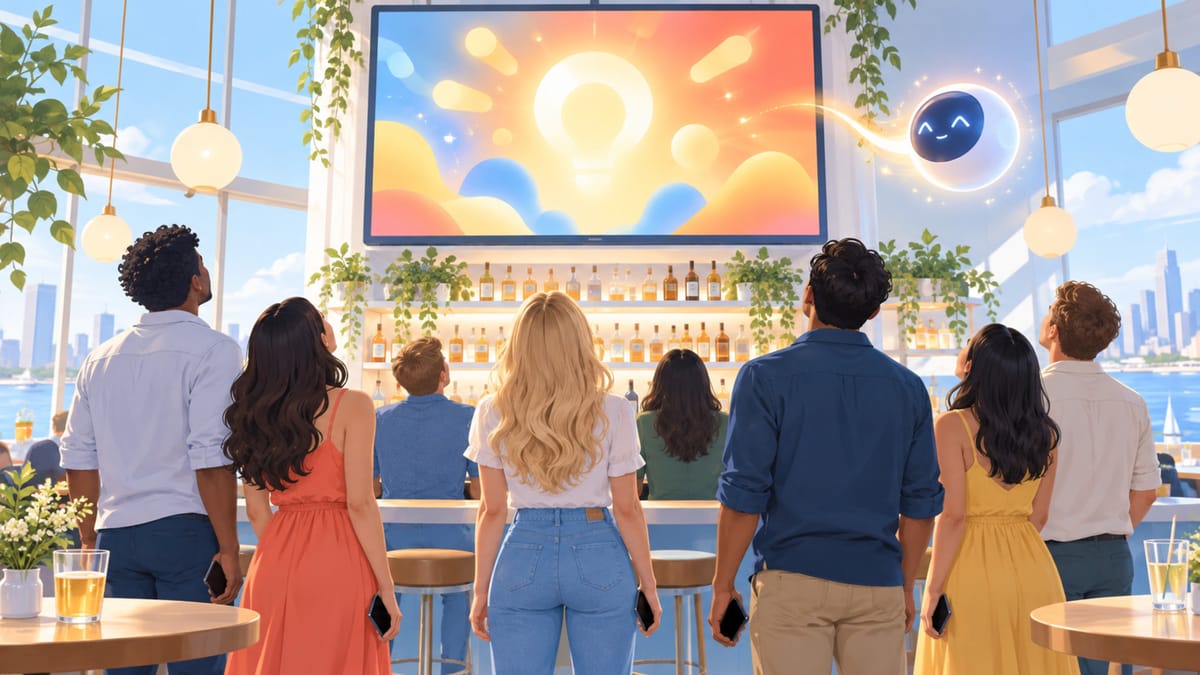
Picture a bar on a Friday night. Forty people packed into one room. Music playing, drinks flowing, the hum of potential conversation everywhere.
And every single person is staring at their phone.
They came here to be together. They're sitting three feet apart. But they might as well be on different continents. Each person locked into their own glowing rectangle, scrolling through other people's lives instead of living their own.
I've been thinking about this problem for two decades. A tool that would hijack that big screen above the bar or in a movie theater and turn it into something people want to look at together. TV and movie trivia. Questions everyone could shout answers to. A reason to put the phone down and look up at the same thing at the same time.
I didn't build it because I'm not a developer and I didn't have the money to hire one. So that idea sat in my drawer of good ideas, perfectly clear, completely stuck.
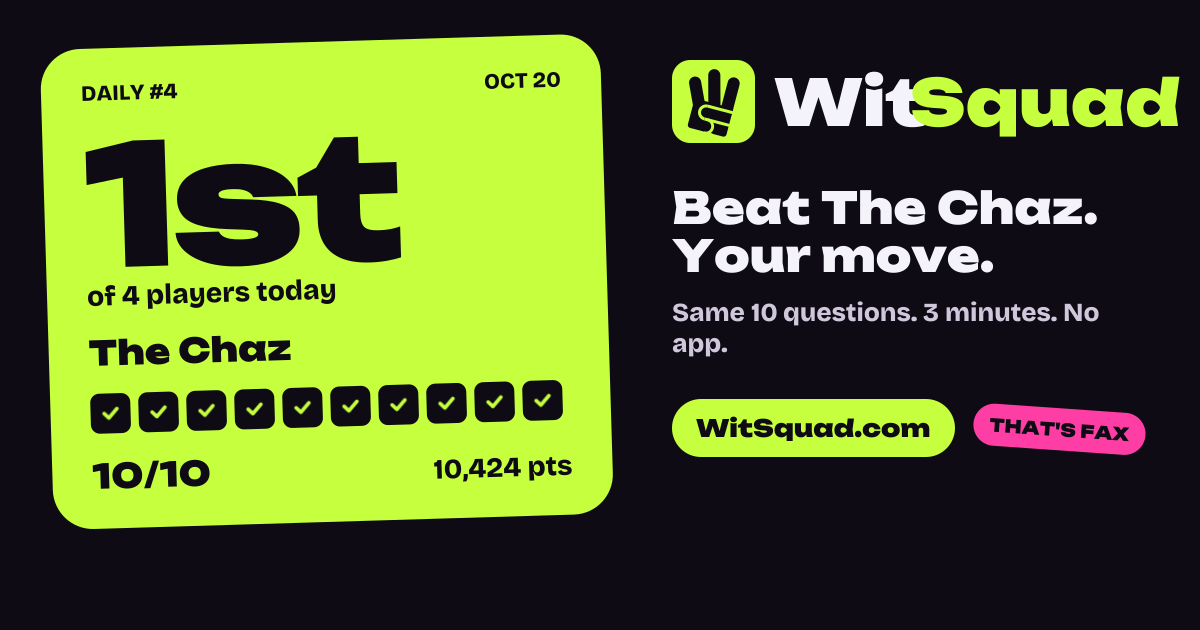
After an awkward train ride last week, I used AI to build it. It's called WitSquad. I think you'll like it!
But this isn't a story about creating an app with AI. It's about what becomes possible when we point powerful technology toward connection instead of isolation.
We've Been Here Before
This problem didn't start with AI. It didn't even start with smartphones.
We've been drifting into private bubbles for years. Walk into a movie theater before the previews start. Twenty years ago, people talked to each other. Strangers made small talk. Couples leaned over and whispered. Now? Hundreds of glowing faces, each person deep in their own feed, building a wall of light between themselves and everyone around them. Movie theaters now have to remind us to put our phones away.
Stadiums. Weddings. Classrooms. Planes. Everywhere humans gather, the same scene plays out. We show up in person, then we disappear into our screens.
The irony is brutal. We're physically together but mentally solo. We traveled to the same place, paid for the same experience, sat in the same room. And then we built separate realities, one per person, and mimicked connection with people we'll never meet.
This isn't a complaint about phones. It's an observation about what every technology wave seems to do. It gives us tools that make us more efficient alone. More entertained alone. More informed alone. And every time, we drift a little further into our own private worlds.
Last week I was on a train home after visiting high school friends in Philly. Fifty people were packed into one car, and not one of them made eye contact with another. At one stop, I noticed a woman struggling with a heavy suitcase, so I stood up and offered to help. She first looked at me like I was a villain. After a pause, she accepted my help, but she still eyed me suspiciously. Helping a stranger felt so strange in that moment that it registered as a threat, not kindness.
That's not a healthy place for humanity to be. And our divide is growing.
Why AI Makes This Moment Different
Here's the part that feels counterintuitive: AI, the technology everyone fears will isolate us most, is perhaps what makes connection-first tech possible.
For years, the barrier to building tools that bring people together wasn't imagination. It was execution. You needed a team of developers. Months of work. Tens of thousands of dollars. A business case someone would fund. Most people with good ideas for shared experiences never made it past that math. The gap between the idea in your head and working software was too wide to cross.
AI collapsed that gap, and I'm one of many jumping in to build new bridges.
A theater director in rural Germany named Jens Nüßle emailed me a few months ago. He uses my teleprompter app, Tellie, when he performs long narrated texts on stage with his band. Buried in his email was an idea he'd carried for years: when an actor blanks on a line mid-performance, what if the app just whispered the next few words into his ear? Not the whole sentence. Two, three, four words. Just enough to jog the memory, then the rest comes back.
I built it in days. It shipped last week in Tellie 1.7 as a feature called Nudge.
Jens wrote back: "I have carried this idea around with me for quite a while, and I think that if I had the technical ability to build something like this myself, I probably would have tried at some point. The fact that we happened to cross paths and that something real may now grow out of part of this idea feels quite remarkable to me."
A man in Germany had an idea. A stranger in Virginia heard it. Now it exists.
That's the shift. The distance between imagination and working software used to be measured in engineers and months and money. Now it's measured in a conversation.
I imagined WitSquad 20 years ago but I couldn't build it then. Then on last week's strange train ride back from Philly, while thinking of a sick friend we couldn't see, I determined to build WitSquad. Not just to help strangers connect, but also to give Mike something fun to do with us even while he remained cooped up in the hospital. Without AI, all of my good intentions would still just be in my head.
What Connection-First Technology Actually Looks Like
Connection-first tech has a specific shape. It gives people something to do with each other, instead of something to disappear into alone.
WitSquad is trivia on a big screen. You scan a code, form a squad with the people next to you, and argue over the answers out loud. Then everyone taps the answer on their own phone. No app to download. No account to create. The phone is a controller, not the main event. The point is what happens between the people holding them.
Pokémon GO did something similar years ago. It got millions of people outside, walking the same streets, bumping into each other at the same PokeStops. Strangers started conversations because they shared a goal. It gave people a reason to move through the real world and cross paths.
That's the pattern. The best use of AI isn't making us more efficient alone. It's lowering the barrier to building things that only work when we're together.
I know people like to share experiences even when they're apart. Families separated by distance. Friends in different cities or in hospital beds. So WitSquad has a Daily mode and a Versus mode. You can compete against each other even when you're not in the same room. That's a great use of tech to close distances, not create them.
The big-screen game is built for a room. The remote modes are there for the people who can't be in it. Either way, the point is the same: give people a reason to pay attention to each other.
The Choice We're Making Right Now
Most of the AI tools I see promise to make one person more productive. One person more entertained. One person more informed. I use those tools too. But that isn't the only thing I want to build.
We're already drowning in isolation. We don't need more tools that make us better at being alone. We need tools that make being together easier, more fun, more valuable than staying in our private bubbles. That's why I believe that the successful tech of the next decade will be judged by whether it brings people together or pushes them apart.
This isn't anti-AI. It's pro-human. I couldn't have built WitSquad twenty years ago. Now I can, and the question is what I choose to do with that. I hear plenty about the bad things AI might do. I also believe this tool, made by humans, can help cure cancer, feed people, and let us be more human with and to each other.
What Happens When We Point AI the Other Way
Imagine classrooms where students engage with each other, not just screens. Weddings where guests actually interact instead of Instagram-ing every moment. Planes where strangers talk. Bars where people look up.
These aren't nostalgic fantasies. They're design choices. If AI can finally make connection-first tech easy to build, it should also make cancer-curing tools and other humanity-serving applications more accessible. A theater director in Germany carries an idea for years. Someone hears it and builds it. Now there's a tool that helps actors perform better, together, in front of live audiences.
Picture that bar again. An experience that engages two people, or five, or forty, all present, all participating, all human.
That's the future I'm building towards, and I invite you to join me.
Or challenge me! Click below!