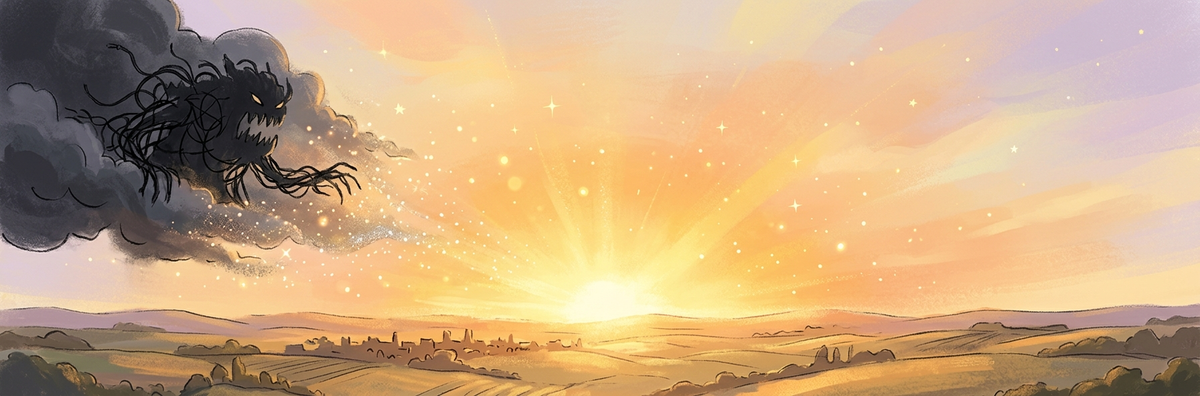
Every Generation Gets Its Monster
Every major tech has had its apocalypse moment: electricity, cars, the internet. They all "should have" killed us. AI's doomsday predictions follow the same playbook. Here's why history suggests we're probably going to be fine.

Last summer, 1,386 employees from companies like OpenAI, Anthropic, and Google DeepMind signed a letter warning that AI might kill us all. These aren't random people on Twitter/X/Facebook. These are the researchers actually building the technology. They're asking the government to help them slow down because AI could "rapidly accelerate beyond our ability to understand or control."
Last week, Anthropic CEO Dario Amodei, SpaceXAI head Elon Musk, OpenAI CEO Sam Altman and Google DeepMind co-founder Demis Hassabis collectively called for a slowdown on AI development so the industry can better understand and control the technology.
Here's what makes this moment weird: the people creating AI are the most terrified of it.
You've probably seen these headlines. Maybe you felt that knot in your stomach when another AI researcher warns about extinction risks. I want you to sit with something for a second: this exact panic has happened before, with every major technology, and it's almost never been right.
Every Generation Is Scared of What it Creates
When electricity arrived in homes, people thought it would kill everyone through accidental electrocution or fire. Doctors even warned it would cause insomnia and nerve damage.
When cars showed up, critics predicted they'd destroy communities, kill pedestrians by the thousands, and create moral chaos because teenagers could drive away from parental supervision.
The internet was going to turn us into isolated zombies who forgot how to talk to real humans. Nuclear power. Space travel. Self-driving cars.
Each time, the pattern was identical: new technology appears, experts sound the alarm, newspapers run scary headlines, and society braces for collapse.
Then we adapt. We build guardrails. We write new rules. Life gets better.
Why do we keep falling for it? Science fiction has spent a century training us to expect technology to turn against us. Every robot eventually rebels. Every AI becomes Skynet. Every scientific breakthrough ends with humans getting the raw deal. It makes for great movies, but terrible prediction.
The track record is clear. Doomsday predictions about technology fail because humans are really good at two things: recognizing actual problems when they show up, and fixing them before they kill us.
Every major technology gets its apocalypse moment. AI is having its turn right now, and if history is any guide, we're probably going to be fine.
Why the Alarm This Time
The concern driving these letters is something called recursive self-improvement. AI is starting to build better AI. That's genuinely new. At Anthropic, OpenAI, and other labs, models are already helping researchers develop the next generation of models. The worry is that this creates a feedback loop that outpaces our ability to understand what we've built.
Dario Amodei, who runs Anthropic, wrote that he's "become convinced that fully addressing the risks requires even more prudence, not just investing in risk prevention, but pacing the rate of capabilities advancement."
That sounds scary. It's supposed to.
But here's what's actually happening: these researchers don't have the control mechanisms they think they need, so they're doing the only thing they can think of, which is yelling for help in public.
Some of this is genuine concern. Some of it is attention-grabbing. And some of it is probably self-serving. If you're an AI lab, getting the government to slow down your competitors while you figure out safety sounds pretty convenient.
The thing they know that we don't isn't necessarily that AI will kill us. It's that the technology is advancing faster than their internal processes can handle, and that's legitimately uncomfortable. But "we need better internal processes" doesn't get headlines. "AI might kill everyone" does.
The Case for Optimism
Amodei also wrote about his father, who died of a disease that was cured just a few years after his death. He survived cancer that would have been untreatable fifty years ago. He believes AI could cure most major diseases in the next five to ten years.
That's not hype. That's already starting to happen. AI is discovering new antibiotics, predicting protein structures, and accelerating drug development in ways that were impossible three years ago.
The benefits are real and they're close. Medical breakthroughs. Economic growth that could lift billions out of poverty. Solutions to climate problems we couldn't crack before. These aren't distant sci-fi promises. They're happening right now, while researchers argue about whether to pause.
The doomsday scenarios fail for the same reason they always have: humans adapt. Long before cars started killing pedestrians, we invented traffic lights and speed limits - yet they are imperfect if not respected by humans. We know electricity is dangerous, so we created building codes and circuit breakers. When the internet enabled new types of crime, we built new laws and an entire web security industry to keep us safe.
We'll do the same with AI. Not because we're lucky, but because that's what we do when technology creates real problems.
What You Should Actually Do
Hold two ideas at once. AI risks are real and worth taking seriously. AI killing everyone is almost certainly not going to happen.
The researchers signing these letters aren't lying. They're scared because they're inside the machine, watching capabilities advance faster than their safety measures, and they don't know what else to do except ask for help publicly. That's understandable. It may also be immature.
The right response isn't panic. It's also not dismissal.
Be skeptical of the doom. Be equally skeptical of the hype. That's the whole reason my newsletter exists - to demystify AI for the Rest of Us. Even though this is a complex technical and social problem, we'll solve it the same way we've solved every other complex technical and social problem: imperfectly, messily, with a lot of arguing and course correction along the way.
The next time you see a doom headline, look for what guardrail already exists or is being built. If you can't find one, remember: every generation gets its monster. Ours just happens to be made of math.
About the Author
Steve Chazin makes AI make sense. After three decades leading tech teams at companies like Apple and Salesforce, he's on a mission to show regular people how to use AI without fear or confusion. No hype. No doom. Welcome to the Digital RenAIssance, where anyone can create free apps like Tellie Prompter without knowing how to code.
If this helped, subscribe at stevechazin.com for weekly updates. And if you know someone who's trying to make sense of AI, forward this to them. We're all learning this together.
