Is AI the Future or the End of Education?
Schools are making opposite bets on the same technology, and the stakes are higher than anyone's admitting. West Virginia is training every student to master AI. Other colleges are banning AI and laptops entirely. Both claim they're protecting the future. So which side got it catastrophically wrong?

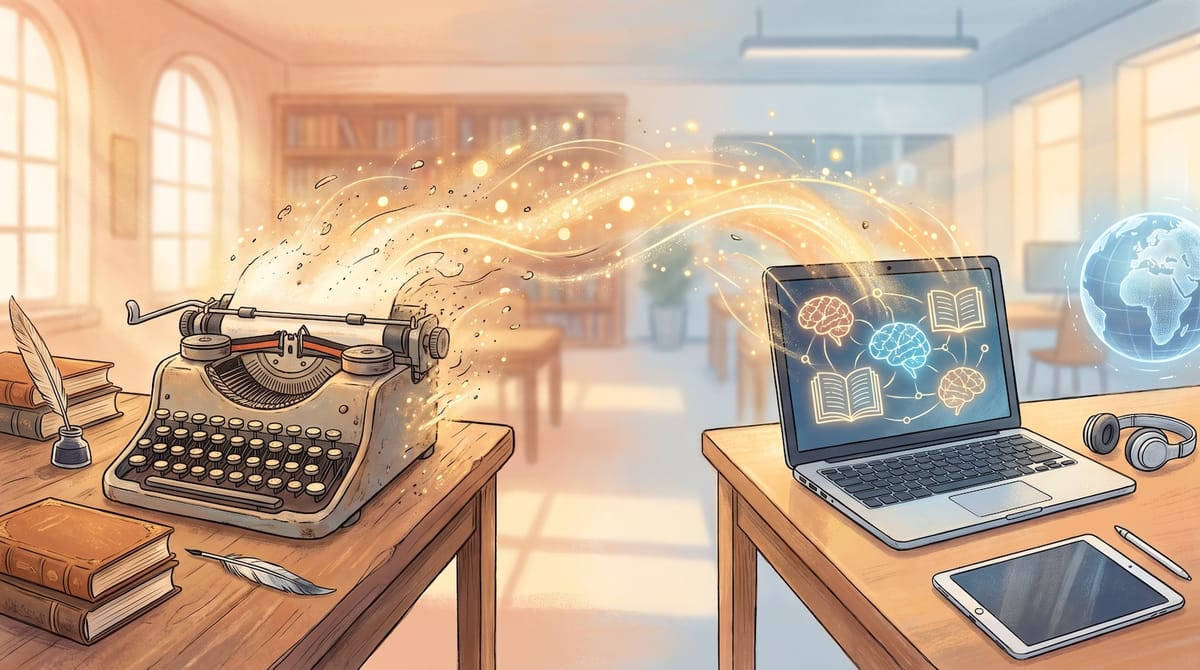
West Virginia just announced they're training every public school student in the state to use AI tools. Every student, every teacher, every principal. They're rolling out Microsoft Copilot access, building credential programs, creating a tiered system where schools earn awards when 80% of their staff complete AI training. Students will progress through levels called "Pioneer" and "Trailblazer" as they master the tools.
Meanwhile, colleges are going the other direction. Some are banning laptops and AI from classrooms and evaluations entirely.
Same moment in time. Same technology. From kindergarten through the university lecture hall, schools are making completely opposite bets. And college is where the stakes get sharpest, because those are the exact years when young brains are wiring themselves for how they'll think for the rest of their lives.
Both sides claim they're protecting students' futures. Both sound convinced they're making the right call. And honestly? That's what makes this so unsettling.
Two Completely Different Bets
West Virginia isn't messing around with their AI initiative. The state superintendent laid out the plan to the Board of Education: comprehensive statewide training starting fall 2026, with summer programs kicking off even earlier. They're leveraging an existing Microsoft partnership to give students access to AI tools "protected within the firewalls and servers, so that there's not a concern about student data or anything getting outside of our K-12 system."
Students can earn credentials through Minecraft Education and Prodigy Learning. Teachers move through tiers with names that sound like a summer camp achievement system: Pioneer, Trailblazer, Ridge Climber. Schools that get 80% of their staff trained earn a "Summit School Award."
The logic is clear: AI is coming whether we like it or not, so we might as well teach kids how to use it responsibly.
On the other side of this divide, some colleges, like University of Chicago Law School are yanking laptops out of classrooms. The reasons vary: AI-assisted cheating, students using ChatGPT to summarize readings instead of actually reading them, attention spans shredded by social media - but the conclusion is the same: computers in class are doing more harm than good.
First, rather than attempting to ban AI or to ignore its risks to learning, our pedagogy and assessment should be designed to ensure our students learn how to think critically and solve legal problems with sound professional judgment. We thus need to ensure that our students do not rely on AI-provided shortcuts that help them produce easy answers but stunt intellectual growth. This requires rethinking the technology we allow in our classrooms, the tasks we assign our students, and the way we assess our students’ performance. – University of Chicago Law School
Coincidentally, also in Illinois, AI is now prohibited from being used for teacher evaluations. Under provisions of Senate Bill 2909, evaluators will be prohibited from using AI to assign a “numerical score or other qualitative rating for any component of a teacher’s evaluation.” [I find this quite ironic, since that’s precisely what teachers have been doing to students since the dawn of time.]
Illinois State Senator Christopher Belt had this to say:
I believe that our teachers should be judged based on actual observations and professional judgement, not by AI software. Our educators deserve a transparent and fair evaluation process that demonstrates their actual work in the classroom and protects their privacy.
These aren't fringe positions. These are serious educators making serious institutional commitments based on what they believe will serve students best.
The tension here isn't just about technology. Both approaches claim they're preparing students for the future. Both claim they're protecting what matters. But they can't both be right.
What College Is Actually Supposed to Do
Here's the thing about college: it's always been stuck doing two completely different jobs at once.
Job one is practical. Train students for careers. Give them skills employers want. Make sure they can get jobs that pay back those student loans and improve their way of life. This is the version of college your parents paid for while asking what you were going to do with that philosophy degree.
Job two is less tangible. Teach students how to think. Help them develop critical reasoning abilities. Turn them into people who can tackle problems that don't have clear answers. This is the version of college that shows up in commencement speeches about becoming engaged citizens and lifelong learners.
For decades, we've pretended these two jobs were compatible. Take your practical major, add some liberal arts requirements, everyone's happy. (Hey, I went to a liberal arts school - Go F&M! - and I tried hard to connect both of these goals.)
But now, this AI moment makes that tension impossible to ignore. You can't teach someone to think deeply while simultaneously handing them a tool that does the thinking for them. You can't develop critical reasoning abilities while outsourcing the hard cognitive work to an algorithm. And you can't prepare students for an AI-driven workforce by pretending AI doesn't exist.
We won't know if AI turns out to be good or bad for education for decades. But we do need to answer this now: What are we actually trying to build in these four years?
The Job Skills Argument Sounds Practical
Fresno State just launched an AI minor open to students across all disciplines. Business majors, agriculture students, computer science people, anyone. Twenty to twenty-one units covering AI fundamentals and how to apply them in your field.
The department chair framed it perfectly: "Whoever wants to get more knowledge about AI, how to apply AI to their own discipline."
The logic makes sense. Employers are asking for AI skills. The Central Valley needs agricultural automation. Rural healthcare could benefit from AI solutions. Students need to be employable when they graduate. Fresno State already had the courses and the faculty expertise. Why not formalize it into a credential that shows up on transcripts?
"When that is printed on the transcript or their diploma, it makes a difference," the chair said, "because that's a specialty that's being recognized by employers."
I get it. I really do. All my children finished college and are still paying down their student loans, and I wanted them to graduate with skills that matter in the actual economy they entered.
But here's what still nags at me. If students use AI to write their papers and think through their assignments and create their projects during the exact years when their brains are supposed to be forming critical thinking abilities, when do they actually develop those abilities?
Neural pathways get built through struggle. Your brain doesn't get stronger by watching someone else lift the weight. And if the AI is doing the heavy lifting during the precise window when your brain is most plastic, most capable of developing new cognitive patterns, what happens to that development?
The shortcut doesn't just save time. It replaces the process that builds the capacity.
And this isn't really about cheating on essays. That's the surface problem, the thing that's easy to police and punish. The real issue is whether an entire generation learns to think deeply at all.
I'm not being dramatic. I'm talking about the basic cognitive work that happens when you sit with a hard problem and don't immediately reach for a tool to solve it. When you read something challenging and have to wrestle with the ideas instead of asking AI to summarize the key points. When you stare at a blank page and have to figure out what you actually think before you start writing.
That struggle? That's not inefficiency. That's how thinking gets built. Once you develop those core skills, AI becomes your best friend. Even though I'm older, I've found AI helping me become more creative and more productive than at any other point in my career. That said, I'm bringing the ambition and drive I built through a lifetime of struggle, failures and successes while AI is now doing the grunt work I used to also have to do.
I've spent enough time around actual workplaces to know that the skills employers say they want and the skills that actually matter are often different things. Yeah, companies want people who can use AI tools. But they also desperately need people who can think critically about what those tools produce. Who can spot the hallucinations and the logical gaps and the places where the AI confidently presents garbage.
You can't develop that judgment without first developing the underlying thinking capacity. And you can't develop thinking capacity by offloading the thinking to AI. The shortcut becomes the default. And twenty years from now, we might be managing a workforce that can prompt AI brilliantly but struggles to think independently when the AI gets it wrong.
Maybe the Answer Isn't Binary
Look, banning AI completely feels like giving up.
It's the educational equivalent of saying "this is too hard to manage, so we're just not going to deal with it." And that doesn't serve students either, because they're going to graduate into a world where AI is everywhere. Teaching them to navigate it, to use it as a tool while maintaining their own thinking capacity, that matters.
But the embrace-it-fully approach feels like we're abandoning the hard work of education in favor of efficiency.
If every assignment can be completed with AI assistance, if every hard cognitive task has an easy workaround, if the path of least resistance is always available, why would students choose the harder path? They're 19 years old. Their brains are still developing impulse control and long-term planning. Of course they'll take the shortcut.
What if the answer isn't picking a side? What if it's guardrails?
Structured limits while brains are still learning to think. No AI-assisted writing in first and second-year courses while students develop their own voice and argumentation skills. No AI summarization tools until they've proven they can read and synthesize complex material themselves. Build the hand saw first, then introduce the power tools.
By junior year, when they've built those neural pathways, when they've struggled through enough hard cognitive work to know what thinking actually feels like, then start teaching them how to use AI effectively. How to prompt it well, how to evaluate its output, how to use it as a genuine collaborator rather than a replacement for their own brain.
It's messier than either extreme. It requires actual thought about which assignments need to be AI-free and which ones can incorporate AI meaningfully. It means more work for professors who are already overloaded.
But it might be the only approach that honors both what students need to develop as humans and what they need to function in the world they're entering.
There's no easy answer here. I wish there were.
College is the place we send young people to discover knowledge, to figure out how they fit into society, to build a foundation for their entire future. That's a lot of weight to put on four years, but it's real weight.
Doing nothing isn't an option. Pretending AI is just another technology shift, like when colleges added computer labs or started requiring email addresses, ignores what's actually different this time.
We're not just adding a new tool to the toolkit. We're introducing a tool that can do the core work we've always used to develop human thinking. That changes everything.
The choice schools are making right now isn't just about education policy or keeping up with technology trends. It's about what we think makes humans human. It's about whether we believe the struggle to think is worth protecting, even when there's an easier way.
I don't pretend to have the answer, and I know many of you have strong opinions and I'd love to see them in the comments. But I know we need to be having a much more honest conversation about what we're willing to lose in the name of preparing students for an AI future.
Because if we get this wrong, we might create that future by accident, a world where AI does the thinking and humans just manage the prompts.
And I'm not ready to accept that as inevitable.
Steve Chazin makes AI make sense. After three decades leading tech teams at companies like Apple and Salesforce, he's on a mission to show regular people how to use AI without fear or confusion. Welcome to the Digital RenAIssance and #AIForTheRestOfUs. stevechazin.com
