AI and the Evolution of the Human Brain
The real story about AI coding isn't code generation: it's about unlocking something our brains have never had before: freedom to create, unencumbered. I call this "vibe creating" and I believe it's the beginning of a new phase in the evolution of the human brain.

AI didn't replace my thinking - it rewired how my brain works. For the first time in my life, I'm inventing ideas, not just products.
As you know, I built Tellie, the Mac teleprompter that listens, named after my granddaughter, Ellie. She's just learning to read. The app was supposed to help me read scripts on camera without looking down at my notes. It works, it's free, and yet two weeks later, I had built something better.
Tellie still scrolls script as it listens to your voice. But now it listens to even more: Keynote presentations, your interview notes, your keystrokes, even your coding agents. It does all this while it stays invisible to Zoom, screen recorders, and anyone watching. A silent secret second screen that surfaces exactly what you need, when you need it.
I did not plan this. I could not have planned this. The idea emerged because I was building, not because I was thinking about building.
That's the thing no one is talking about with AI coding. The story isn't "non-developers can now ship apps." The story is "building software is changing how human brains generate ideas."
This might be bigger than we think.
The Real Story Isn't Code Generation
Traditional development worked like this: think of an idea, write a spec, hire someone or learn to code, build the thing, ship it. Linear. Sequential. Constrained by how well you could translate the picture in your head into words on a page.
Vibecoding works differently: start building an idea, discover a new angle mid-build, pivot immediately, discover another possibility, keep building. Iterative. Generative. Constrained only by how fast you can test what you're imagining.
The key difference? In traditional development, you think then you build. In vibecoding, building is thinking.
If you're not a coder, don't stop here because this is not that different from writing a story, creating music, drafting an email. And you are a coder even if you never coded in your life - just like me. Keep reading.
I've been in tech for 30 years. I helped bring Apple back to profitability under Steve Jobs. I've launched startups and shipped products used by millions. Yet, I've never experienced this before - this sensation that the act of creation is generating thoughts I would not have had otherwise.
New use cases appear while I'm testing a feature. Delightful, magical experiences emerge that I didn't write down in any plan. The AI isn't getting smarter during this process. I am.
The AI isn't getting smarter during this process. I am.
It's building new pathways in my brain, not the machine's.
We might need a new word for this. Vibecoding implies the code is the output. But the code is the byproduct. The real output is expanded cognitive capacity. Maybe we're vibe-creating.
Why This Feels Different From Every Other Tool
Excel made spreadsheets faster. Photoshop made image editing accessible. Even early no-code tools made existing work easier to do.
Vibecoding makes new work possible by changing how you think.
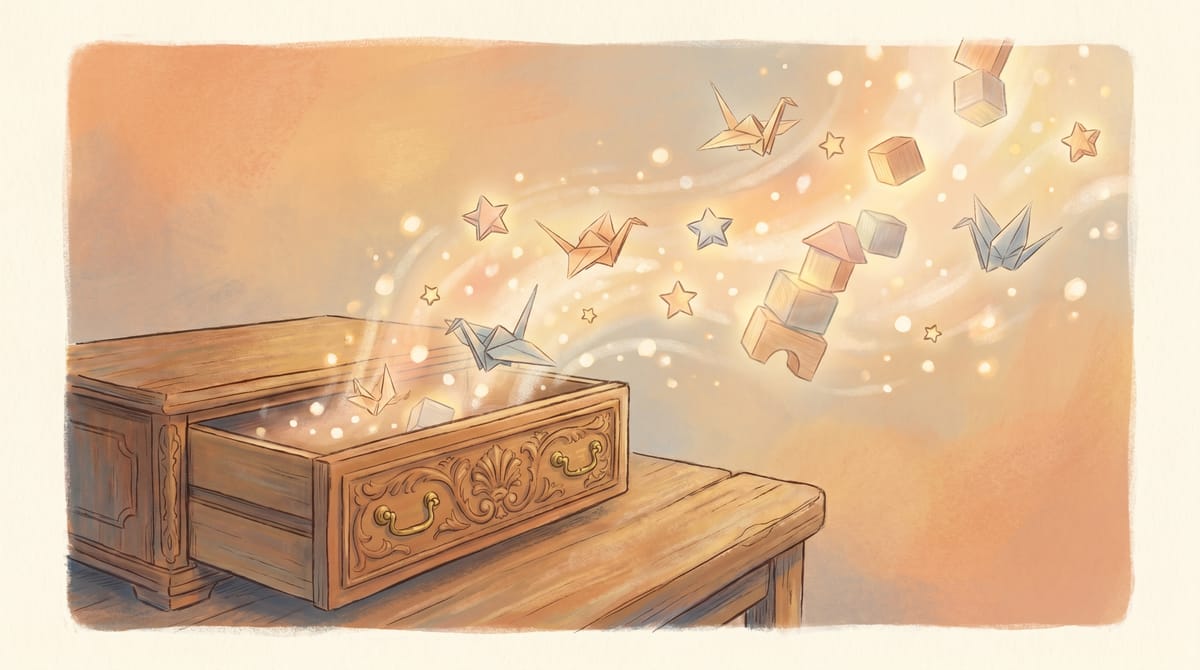
For three decades, I've carried around a mental drawer stuffed with ideas that never became real. Not because they were bad. Because the path to making them real was too expensive, too slow, too dependent on someone else translating my vision.
That drawer wasn't a pipeline of developer jobs. It was a graveyard. The economics never made sense. Hiring a developer for a personal project app? For something I wanted to exist but had no business model for? For an internal tool to scratch my own itch?
AI didn't replace jobs here. It filled a void. It turned lost ideas into reality.
Here's what changed: the translation cost dropped to zero.
I don't need to write a 12-page spec explaining the edge cases. I don't need to learn Swift and debug scroll physics. I describe what I want, the AI builds it, I see it running, and that artifact - that working prototype - sparks my next idea.
For me, the friction between thought and thing disappeared. And when that friction disappears, your brain starts working differently.
What Actually Gets Unlocked
Traditional brainstorming is limited by what you can articulate. You sit in a room, whiteboard some concepts, write user stories, draw wireframes. You're trying to imagine the future before it exists.
...the friction between thought and thing disappeared.
Vibecoding flips this. You discover ideas you couldn't have articulated in advance because you're iterating on a real, working thing.
Tellie started as a teleprompter. I built that. It worked. I used it. And while using it, I noticed something: I kept switching away to look at notes, references, interview questions. The teleprompter was solving one problem (eye contact) but creating another (context switching).
So I asked: what if it listened? What if it could follow what I was working on and pull up relevant content automatically?
Let me show you what I mean about vibe-creation
Good example. After I figured out that the notch was a special place on my Mac, I thought: how can I send what I'm looking at to that notch, without cut-copy-paste, or Save As/Open, etc. so I imagined "Send to Tellie" a simple feature that works like this: highlight text inside any app, then hold down the three keys to the left of the spacebar on Mac (control-option-command) and press the letter "T". Magically, that content is now in Tellie Pulse (the one line preview you see in this image):

Then when I mouse over it, Tellie expands:
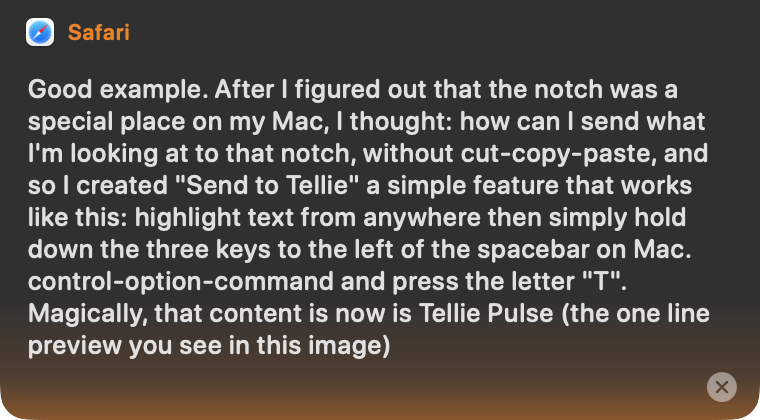
And if I click on Tellie, it opens up, ready for teleprompter mode so I can read it while it scrolls without breaking eye contact with the camera in the notch:
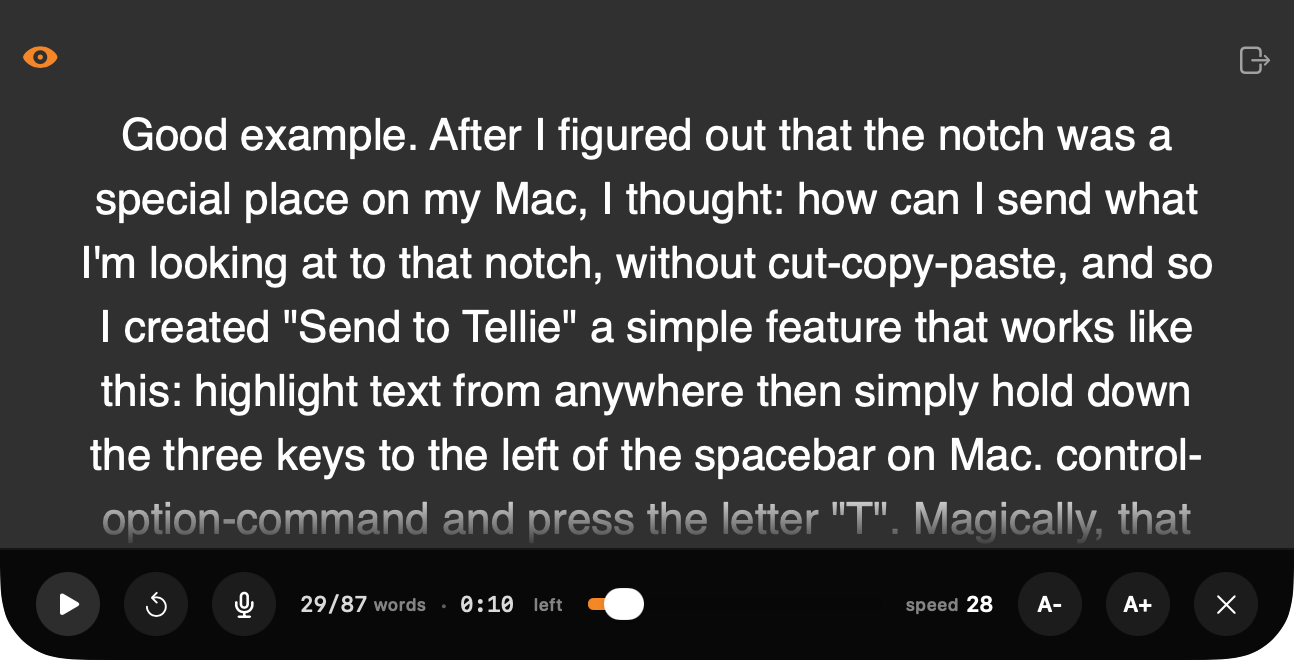
That idea only emerged because I was in the act of building. I wasn't brainstorming in a vacuum. I was using the thing, feeling the gaps, exploring possiblities, iterating immediately. Later, Presenter Mode popped into my head the same way and was built in less than 2 hours, while I was conversing with 3 other people at the office.
This is the opposite of "AI replacing human creativity." AI is removing the friction between thought and artifact. It's letting you iterate on ideas at the speed of thought instead of the speed of hiring, speccing, and waiting.
For executives, here's the question that matters: what changes if your team can prototype and test ideas in days instead of quarters?
What strategic options open up when the cost of experimentation drops by 90 percent? What markets become accessible when you can validate a hypothesis with a working product instead of a pitch deck?
Speed isn't the only advantage. It's the cognitive unlock. People start thinking differently when they can build immediately. They propose ideas they would have filtered out before because "that would take six months to build." Now it takes three days. The filter comes off. The drawer opens.
For employees, what more can you do if you unlock your brain while in your current job...or when the next one arrives because now you have new skills you built yourself.
The Impostor Syndrome Is a Feature, Not a Bug
I launched Tellie last month. Hundreds of people are downloading it. Using it. Emmy award-winning actors like Sprague Theobald are emailing me asking to create new features for them. Some are buying my Pro version. Proving that Tellie solves a real problem.
And I keep asking myself: should I be proud of this?
I didn't write the Swift. I didn't debug the scroll physics. I talked to an AI and it wrote the code. Am I allowed to feel good about that?
That discomfort signals something important. The rules of creation are changing, and our brains haven't caught up yet.
Old model: pride came from mastering the craft. You earned the right to call yourself a builder by learning the syntax, the frameworks, the deployment pipelines. If you didn't pay those dues, you weren't real.
New model: pride comes from the idea and the execution, not the technical implementation.
No one questions whether a photographer is a "real artist" because they used a camera instead of painting by hand. The tool doesn't diminish the vision. Ansel Adams didn't mix chemicals and grind glass for his lenses. He saw something, framed it, and clicked.
For leaders, this shift matters more than you think. If your competitive advantage depends on gatekeeping technical skills - if your moat is "we have developers and you don't" - you're already losing.
The advantage now is speed of iteration and quality of ideas. Can your team test hypotheses faster than your competitors? Can they learn from real user behavior instead of projected behavior? Can they kill bad ideas in days instead of quarters?
That's the game. And vibe creating just changed the rules.
Why This Matters More Than You Think
Here's my actual claim: AI's real value isn't replacing tasks. It's expanding human cognitive capacity in ways we're just starting to understand.
If vibecoding changes how people think - not just what they can build - we're looking at a compound effect.
More ideas tested means more learning. More learning means better judgment. Better judgment means better ideas. Better ideas mean faster movement. Faster movement means competitive advantage. Vibe-creating creates more.
This isn't linear improvement. It's exponential. And it's happening right now to anyone willing to open the drawer and start building.
The strategic implication for companies: if you can systematize this discovery process - if you can create environments where your people are vibecoding regularly, testing ideas immediately, iterating based on real artifacts instead of imagined ones - you will move faster than companies still optimizing the old pipeline. The implication for workers: your brain gets unlocked while automation handles the grunt work while your company - and you - grow.
This isn't about developers versus non-developers. It's about unlocking a whole class of builders who were locked out before. People who had ideas but no instrument. People who could see the future clearly but couldn't make it real.
Your organization is full of those people. They've been carrying around drawers stuffed with ideas for years. Waiting for permission. Waiting for budget. Waiting for someone else to translate their vision.
What happens when you give them the ability to build it themselves?
The Drawer Is Now a Liability
If you're a leader and you're not experimenting with this, you're not just behind on tools. You're behind on how your people could be thinking.
That drawer full of dead ideas? It's not neutral anymore. It's a competitive liability. Every idea in there represents a market insight, a customer pain point, a strategic opportunity that you saw but didn't act on.
Your competitors are acting on theirs. Right now. In days, not quarters.
You also might have native geniuses on your team who just need the drawer in their brain unlocked. People who've never written code but think in systems. People who see solutions but can't articulate them in tickets and wireframes.
Give them access to AI coding tools. Not as a replacement for your developers, but as a creative gym. A place to build brain muscle they've never been able to use before.
Watch what happens. You might be surprised by who starts shipping.
I named Tellie after my granddaughter. She's learning to read right now. Learning how symbols become sounds, sounds become words, words become meaning.
I'm learning something similar. Learning how thoughts become prototypes, prototypes become insights, insights become new thoughts I couldn't have had before. I thought I was building a teleprompter that lives in the Mac notch. Then I realized the notch is a canvas. Tellie is what makes it listen.
Listen to your heart. Your idea drawer is open.
Start building.
Steve Chazin makes AI make sense. After three decades leading tech teams at companies like Apple and Salesforce, he's on a mission to show regular people how to use AI without fear or confusion. Welcome to the Digital RenAIssance and #AIFortheRestofUS stevechazin.com