Permission to Think Different
When building software was expensive, you learned to stop dreaming. Now that the cost of creation is nearly free, something unexpected happens: you start inventing ideas you couldn't have imagined before.


I had a drawer full of good ideas that never saw the light of day because I couldn't build them myself, and hiring someone never made sense. Yet, a few months ago I made a Mac app without writing a single line of code and now people are using it and writing to me with feature requests.
What changed? AI enabled me to realize my good ideas and create even better ones.
When Building Was Expensive, Thinking Was Constrained
The old world worked like this: think of an idea, write a full specification, hire someone or learn to code yourself, build the thing, ship it. Hope people love it.
As expensive as that process was, the real cost was the ideas you never let yourself have in the first place. Because even if you had a remarkable idea, the moment your team or your manager got involved, your vision would begin to flatten. You'd negotiate away the details that made it interesting because it was too hard, too expensive, too risky, or too different from what your colleagues were thinking. So you'd sand off the edges, simplify the product, and in the process compromise on your vision. By the time the first iteration got built, the thing you were holding was no longer the thing you had imagined.
Over time, you learned to edit yourself earlier in the process. You'd have an idea and immediately ask: can I explain this clearly enough? Will someone want to build it? Is it worth the friction? Most of the time, the answer was no. The idea went in the drawer. Or it never made it out of your head in the first place.
I built Tellie, a Mac teleprompter app, expecting to think faster. What I got instead was permission to think differently.
Building Started to Feel Like Thinking
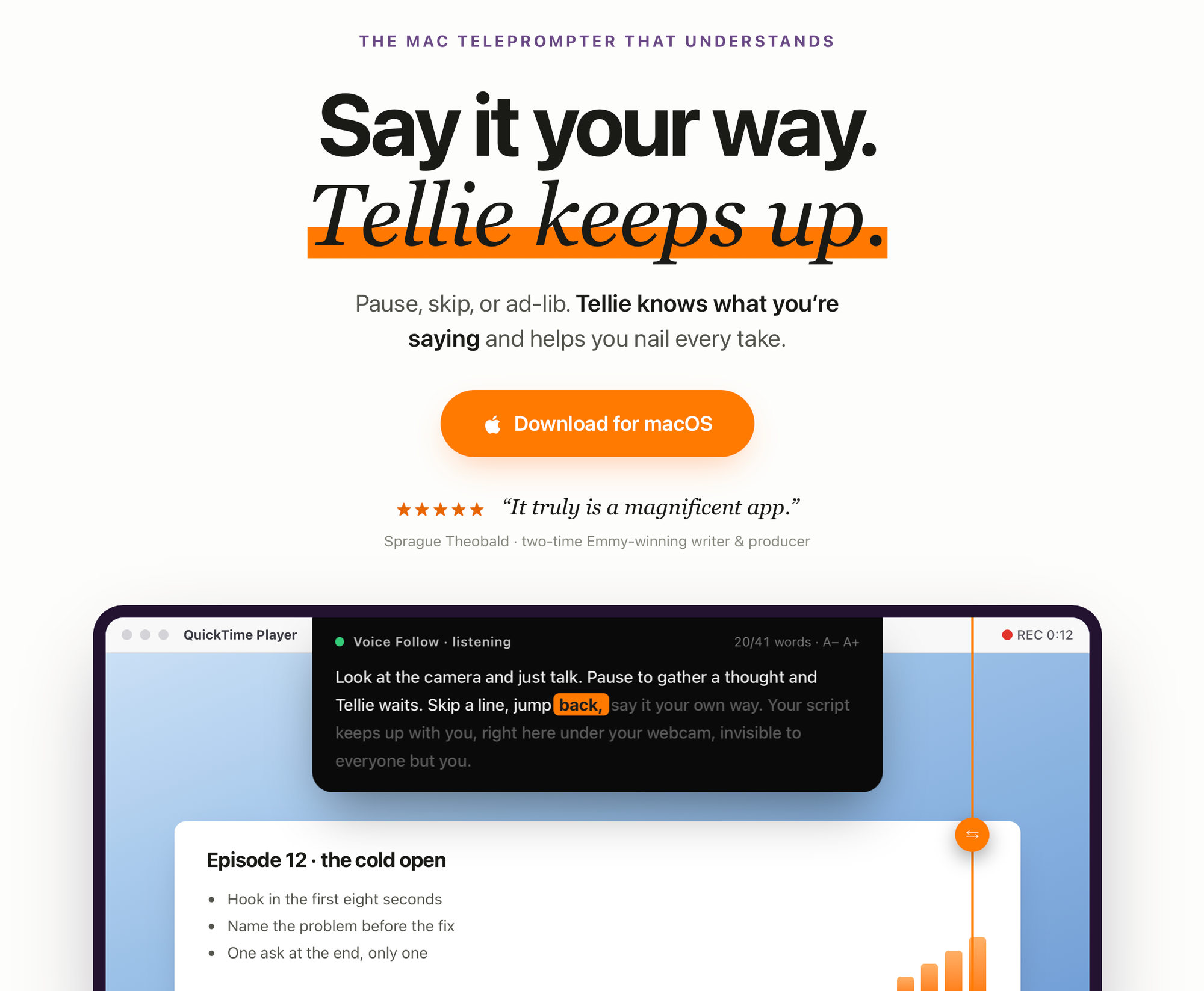
I started with a simple idea: a teleprompter that didn't suck. I wanted it for myself to record videos without breaking eye contact with my camera. That's it. One problem. 3 days.
But something strange happened while I was building it. Features appeared that I never could have specified or imagined.
- Voice Follow: Most teleprompters just scroll and force you to match their pace. So I invented a way to match each word you speak to your script so you can pause, skip ahead, circle back, and Tellie simply waits for you to come back.
- Send to Tellie: A way to pipe text from anywhere to the notch instantly. I needed a way to surface content no matter where I was and found it magical to not have to open a file or even copy/paste. I didn't plan for it. I bumped into it. Eventually I invented a way for a website or even a URL to send content to Tellie.
- Presenter Magic: I wanted to see my presentation AND my notes without needing a second monitor and to keep my notes invisible from Zoom or screen sharing. Later I invented a way to flip ahead without a clicker just by speaking the last word on that slide.
- Companion: One user wrote to me about how she loves Tellie, but has intense stage fright and needs her notes on her iPad as she paces the stage. That need inspired a simple web server that lets you control your Mac from your iPad or any browser - and even watch your important points check themselves off as you cover them (great for teachers and salespeople!)
- Stagehand. This one's the wildest. A teleprompter that knows what you didn't say. It listens while you read, and helps you cover the important parts without running out of time. I needed this so I could to stay focused on what I want to say even when I use different words, and to get coaching when I finished each take.
I woke up at 3 AM with the Stagehand idea in my head. Not because I sat down to brainstorm features. Because I'd been inside the problem long enough that the problem started talking back. That's really my main point: I never could have written any of those features into a spec before I started.
Most of these differentiating features only appeared because a portion of my brain was unlocked now that I was finally unencumbered by friction, fear or finances. I didn't have to convince anyone to build these features, or write a document explaining why they mattered, so the feedback loop collapsed. Building started to become thinking. That's different.
Honestly, the only feature I was adamant about at start was privacy: not requiring any account, having no tracking, running entirely on device, and staying completely private without the use of AI. That's the reason the entire download is only 4 MB in size and complete free to use.
Dreams are Free Now
In the old world, building was expensive, time consuming, and required resources that could work on other projects, so you needed a plan. You thought first and then you built. But when building stops being expensive, the order reverses. You build to think. You discover what you actually want by making it and using it and breaking it and fixing it. The ideas don't come before the work. They come from the work.
When I imagine something now, I don't immediately worry whether I can explain it or afford it or convince someone else to care. I just start building. If it's wrong, I'll know soon enough. If it's right, I'll know even sooner. The cost of being wrong dropped to almost nothing, so I can be wrong more often. Which means I can try things I never would have let myself try before.
I urge you to try this new way and you'll find out that you are not just inventing products. You’re inventing ideas you couldn't have thought of before. Ideas that only appear when you're inside the work, not outside it planning. Your imagination grows because the ideas that used to die before they were born now get built and tried and rebuilt. And some of them turn into something special.
What This Means for You
What's in your drawer? What have you stopped letting yourself imagine because the gap between thought and thing was too wide?
My drawer is no longer a place where ideas go to die. It's more like a garden. Ideas go in, grow into other ideas, branch off into things I never expected. Some of them turn into real products. Some of them teach me what I actually wanted in the first place.
I'm not just building faster. I'm thinking differently. And once that shift happens, you can't go back. You can't un-know what it feels like to imagine something and then make it before the idea gets cold. You can't pretend the barrier is still there when you've already walked through it.
Those ideas you never realized because you couldn't build them are still out there. They are waiting for the moment you stop negotiating with the old constraints and start imagining what happens now that you finally have the freedom to think differently.
Steve Chazin makes AI make sense. After three decades leading tech teams at companies like Apple and Salesforce, he's on a mission to show regular people how to use AI without fear or confusion. Welcome to the Digital RenAIssance and AI for the Rest of Us. stevechazin.com